This is my obsession with noise, it’s because what many people hear as just noise, I hear as an entire world. After more than twenty years of exploring it, I still feel like I’ve only scratched the surface.
Contents
Concept
Chain Shot is built around the idea that sound sources are never neutral. Every slot in the matrix carries a history with it: worn tape, magnetic fields, mechanics that jam. It is not a traditional sampler. It is a system for building layered textures where the dirty sound of machines is an integral part of the language.
When I was working on this I kept thinking about Aaron Dilloway — his tape practice, the way malfunction becomes composition. That approach has always meant a lot to me. Chain Shot is an attempt to bring that logic into a live environment.
Watch
The Core Idea — Polyphonic Drift
Each of the six sampler slots has four independent drift parameters: wow depth, wow rate, flutter depth, flutter rate. S7 adds mechanical wow on the motor rotation. S8 adds ELF beating between oscillators. When you run multiple slots simultaneously through the matrix, none of them are drifting at the same rate or depth.
This is not an effect. It is a tuning system. Every slot is slightly out of phase with every other slot, all the time, in a different way. The result is a continuously evolving interference field — beating frequencies, phase cancellations, accidental unisons that appear and dissolve — none of it repeatable, none of it quantized to a grid.
The more slots you activate, the more complex the interference becomes. With eight sources drifting independently, the matrix stops being a mixer and starts behaving like an acoustic space with its own resonant modes.
Wow — slow pitch drift (tape capstan irregularity)
Wow operates in the sub-2Hz range — below the threshold of vibrato perception, so it reads as pitch instability rather than modulation. Set six slots to different wow rates and the phase relationships between them become completely unpredictable over time. Two slots tuned to close but different wow rates will beat against each other with a period that can last minutes.
Flutter — fast pitch turbulence (tape transport irregularity)
Flutter operates in the 4–12Hz range — inside the vibrato zone — but because it uses filtered noise rather than a sine LFO, it does not sound like vibrato. It sounds like a tape transport that cannot maintain constant speed. At high flutter depth with multiple slots, the combined signal develops a grainy, almost granular texture — not from grain processing, but from the pitch interference between tracks.
Useful combinations
Two slots with identical content, identical speed, but different wow rates: the result is a slowly beating unison that widens and narrows over time — closer to acoustic instrument tuning drift than any chorus or detune effect.
High flutter depth across all six slots with different rates: the combined signal loses pitch definition entirely and becomes a noise texture that retains the spectral character of the original material.
Slow wow on S1–S3, fast flutter on S4–S6, S7 motor active: three layers of temporal drift operating at completely different timescales simultaneously. The matrix routing determines which combinations of these reach each output channel.
Mangle All randomises all parameters simultaneously — speed, pan, shift, ring mod, wow, flutter across all slots — useful for breaking a static configuration and finding new interference patterns you would not have set by hand.
Interface Overview
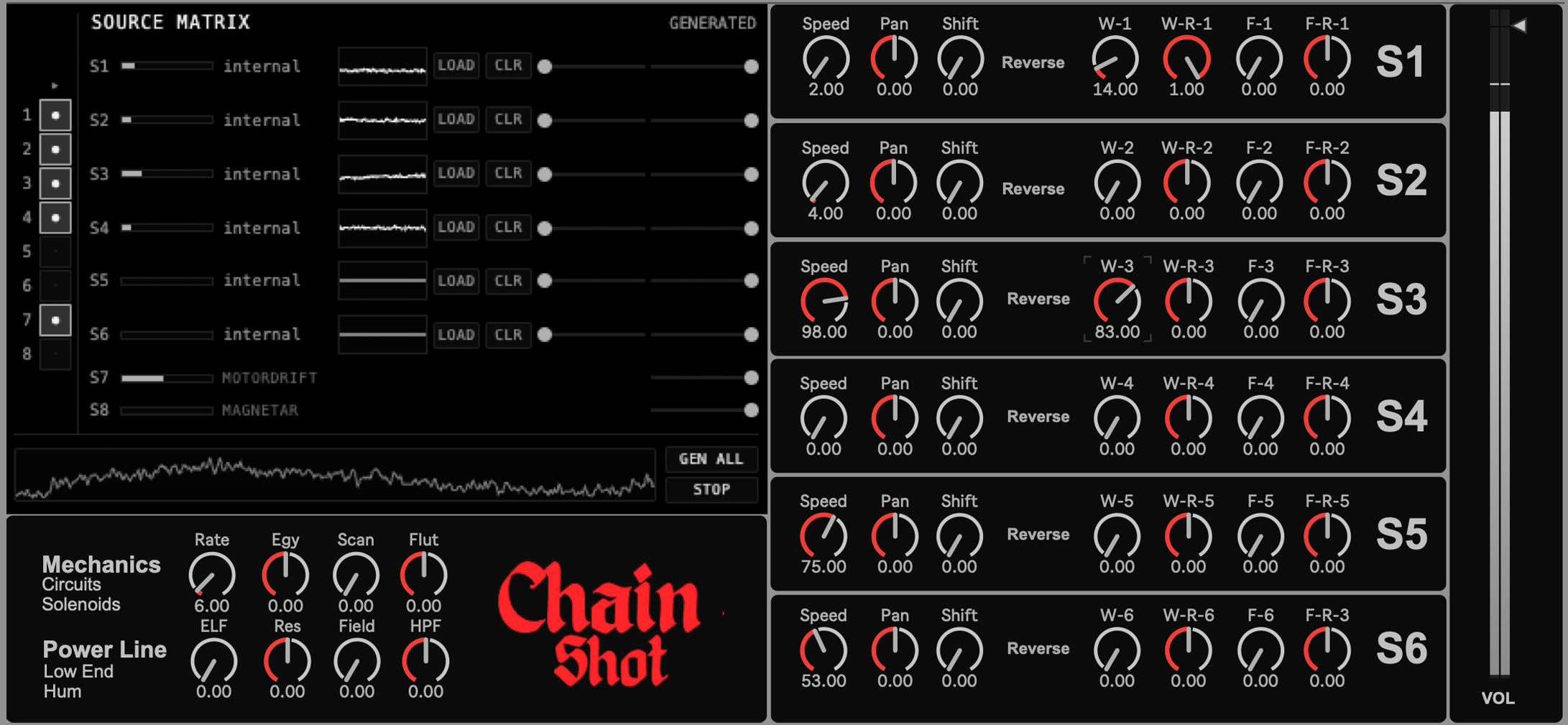
1 — Source Matrix. The central matrix. 8 source slots (S1–S8) across 8 routing columns. Each cell activates or deactivates the signal of that source on that channel. GEN ALL and STOP control everything simultaneously.
2 — Tape Deck. Controls for the 6 sampler slots (S1–S6). Speed, Pan, Shift, Wow, W-Rate, Flutter, F-Rate, Reverse per slot.
3 — Engine Panel. Controls for S7 (Mechanics) and S8 (Power Line). Internal generative sources, always running when activated in the matrix.
S1–S6 — Sample Slots
The first six slots are samplers. Load an audio file with LOAD, clear with CLR. The inline scope displays the live waveform of the outgoing signal. The slider to the right of the filename controls the slot volume; the second slider is vinyl noise — analogue noise layered on top of the signal.
Each slot has a level meter on the left and an inline scope between the filename and the LOAD/CLR buttons.
Speed / Pan / Shift / Reverse
Wow & Flutter
Wow and flutter are independent per channel. Combined with different speed and shift values across slots, they generate unpredictable phase beating inside the matrix routing.
The Speed dials for S2 and S4 are mapped to a range of 1–127 instead of 0–2. Playback starts at audio rate: past this threshold the material stops being recognisable as such and enters glitch, extreme granular, and pitch destruction territory. Use them as high-speed texture sources to mix against the other slots.
S7 — Mechanics
S7 is a mechanical motor simulator. Not a synth, not white noise — it is the physics of a machine that works and does not work well. A sinusoidal fundamental with harmonics, wow and flutter on the rotation, brown-band rumble, commutator brush clicks, belt noise, intermittent solenoids.
When you deactivate it in the matrix it slows down gradually, like a tape deck losing power. The spindown time depends on the speed setting.
Parameters
S8 — Power Line
S8 is an ELF/ULF field generator — the kind of frequencies that come out of transformers, high-voltage power lines, unshielded guitar pickups near a monitor. A cluster of four sine oscillators beating against each other in the sub range, with a fixed LP filter and an optional controllable brown noise layer.
Parameters
Oscilloscopes
Each sampler slot has two scopes: the level meter on the left and the inline scope in the row between the filename and LOAD. Both draw the time-domain waveform from the deck's meterAnalyser. The global scope at the bottom reflects the master mix after the waveshaper. All scopes are amplified 6x for readability on weak signals.
Routing Notes
Max messages reach channels via send --deck1 … send --deck8. Prepends go to the inlet of the corresponding receive object. S7 and S8 receive their initial values via route ready on outlet 3 of the jweb~ when the device loads.
Mangle All
Mangle All is a global randomiser for all exposed parameters in the device. A single trigger generates a random configuration across all parameters — speed, pan, shift, ring modulation, wow depth, wow rate, flutter depth, flutter rate for all six sampler slots, plus the engine parameters for S7 and S8.
In a device built around matrix logic, the value of Mangle All is not finding presets — it is breaking habits. When you work on a texture for a while your hands tend to return to the same values. Mangle All cuts that loop: it generates a configuration you would never have chosen by hand, which is often exactly the right one.
Use it as a starting point for manual refinement, not as a destination. The result of a mangle is almost always chaotic — the work is figuring out which of the randomised parameters is worth keeping and building around it.
Reference
The sonic logic of Chain Shot draws from Aaron Dilloway's tape practice — the way physical degradation and mechanical malfunction become compositional tools. I have watched this performance probably a hundred times. For me it is his most significant work.

Open a slot. Move something. Listen.