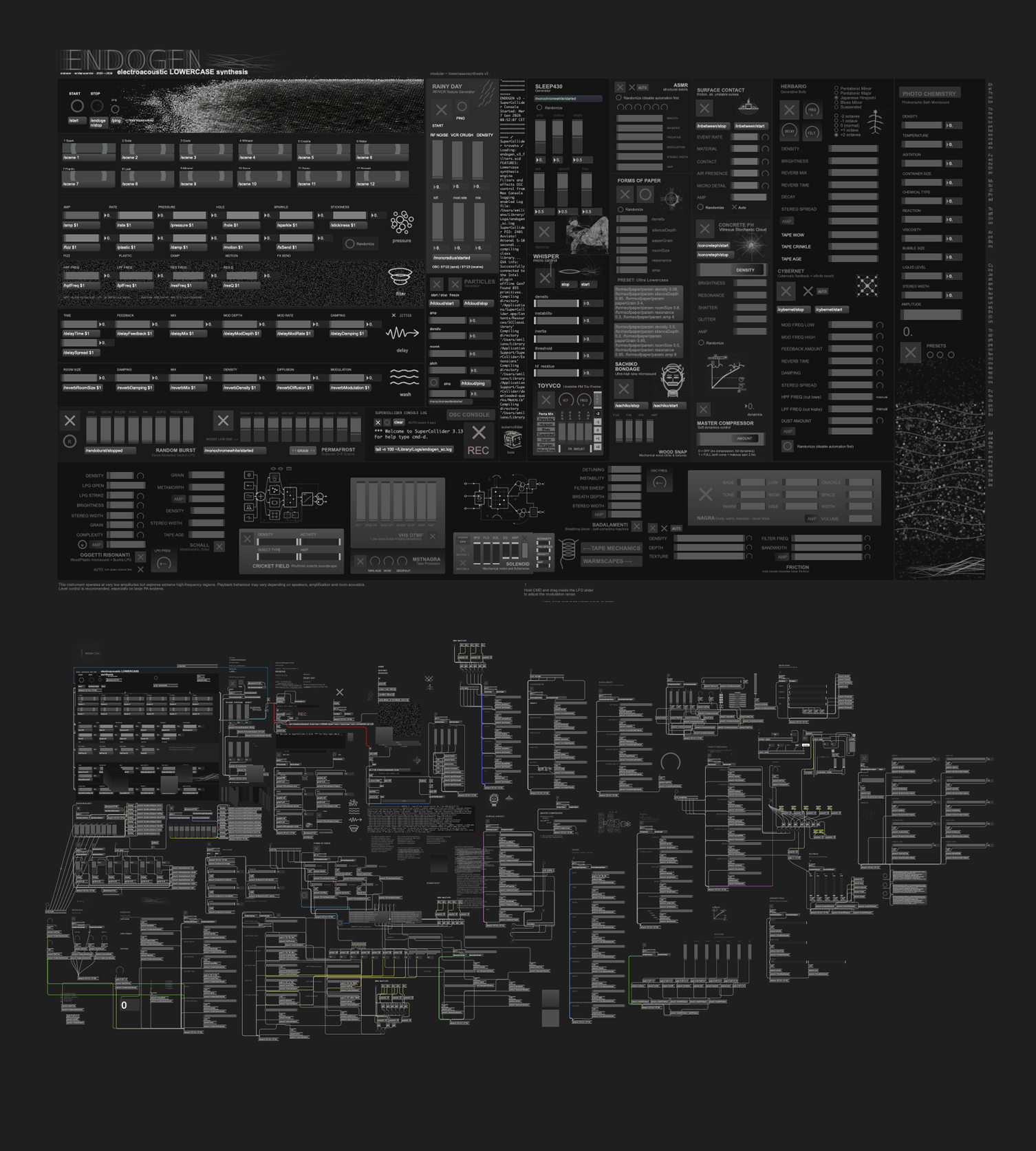
Requirements & Usage Options
ENDOGEN runs seamlessly on both macOS and Windows, offering full window resizing and optimal performance across platforms.
Available in two formats: .maxpat for full editing control (Max/MSP users) and .mxf for use with the free Max Demo version (full functionality).
System Requirements
| macOS | macOS 10.13 (High Sierra) or later Tested and stable from macOS 10.13 onwards |
| Windows | Windows 10 (64-bit) or later Windows 11 fully supported |
| Processor | Intel Core i5 or Apple Silicon (M1/M2/M3) or equivalent Multicore processor recommended for optimal performance |
| RAM | 8 GB minimum, 16 GB or more recommended Higher RAM improves performance with multiple synthesis layers |
| Display | 1366×768 minimum resolution 1920×1080 or higher recommended for optimal interface experience |
| Audio Interface | Professional audio interface recommended ENDOGEN operates at very low levels - quality monitoring essential |
| Software | Max Demo (free) provides full functionality Download free from Cycling '74 - includes complete recording capabilities and dual-channel stereo output |
What's Included
ENDOGEN comes in two formats to suit different workflows:
For Max/MSP Users
Full editing access and complete control over the patch structure. Explore, modify, and customize
the entire synthesis architecture.
Requires: Max/MSP license (full version)
For Max Demo Users
Runs with the free Max Demo version with full functionality including complete recording capabilities
(dual-channel stereo output). Window resizing supported on both Mac and Windows.
Requires: Max Demo (free download from Cycling '74) — replaces previous Max Runtime
Usage Options
| Max/MSP Owners | Use .maxpat for complete control and editing capabilities |
| Max for Live Users | Use .mxf - Max Demo provides the same functionality as the previous Max Runtime |
| Other Users | Download the free Max Demo from Cycling '74, then use .mxf version (full functionality including recording) |
Note: ENDOGEN is a standalone synthesis environment that runs independently as its own application, not inside a DAW. Both formats also require SuperCollider (included in package with setup instructions).
| With Max/MSP License | Open patches directly in Max — full editing and customization available |
| Without Max/MSP License | Use standalone app with free Max Demo — complete functionality, full recording capabilities (dual-channel stereo), ready for performance and production |
Overview
ENDOGEN is a modular lowercase synthesis environment built around microsound, drift, feedback, and near-silence. It includes two generative oscillators and ten additional oscillators with direct frequency control, all of which can be individually tuned and operate within constrained pitch structures, featuring octave scale shifting and continuous frequency control.
Beyond this, ENDOGEN includes 14 complex modal synthesis modules modeled after vactrol-like dynamics and the frequency responses of tapes, cabinets, and amplifiers. These modules do not aim for faithful emulation, but for behavioral resemblance: slow energy transfer, asymmetric decay, spectral bending, and subtle saturation.
ENDOGEN is particularly suited for the creation of deep atmospherical drones grounded in lowercase and microsound aesthetics. Long-duration sound masses evolve slowly near silence, shaped by drift, feedback, and internal instability rather than gesture or rhythm. Micro-variations in spectrum and amplitude become the primary musical material, allowing drones to feel physically present, fragile, and continuously alive even at extremely low listening levels.
Designed for Listening, Performance and Recordings
ENDOGEN is built for live performance and studio work. Its architecture supports extended listening sessions, real-time manipulation during performances, and direct recording of its output for use in compositions and sound design projects.
~150 continuous parameters
Small numeric changes affect long-term behavior rather than immediate results.
ENDOGEN 9.0 ~ Complete ITB Synthesis System
With this update, ENDOGEN positions itself at the very top of the most complete ITB systems available, spanning nearly the entire spectrum of synthesis methods — from microscopic sound design to massive spectral structures.
The new synthesis modules and dedicated noise architecture expand the system's range from organic micro-chaos to glacial sub-mass, while maintaining the lowercase, microsound and drone aesthetics at the core of the ENDOGEN philosophy.
New Modules
| BIRDY | Chaotic bird synthesis & VLF radio—micro-spikes, hiss, crackle, and dusty vinyl/tape grain designed for lowercase headroom. Dynamic filtering tied to FREQ: low frequencies dark and compact, higher frequencies bright micro-detail |
| HARMONIC SHIMMER | 99 resonators transforming a single fundamental into slowly breathing harmonic clouds. Subtle drift and varied decay times create static-yet-alive sound mass with wide spatial suspension |
| TECTONIC WAVETABLE | Deep sub structures with 16 real-time harmonic controls for dynamic wavetable sculpting. Dark filtering, sub reinforcement, and glacial reverb produce slow, monumental textures with geological motion |
| NOISE DESIGNER / NOISEMIX | Electromagnetic fields architecture—multi-lane noise engine with parallel processing (clipping, stepped sampling, rounding/quantization, bit-style degradation). Per-lane trim for ultra-subtle balancing down to near-silence |
| Vinyl | Analog vinyl surface noise generating organic crackling, pops, dust and rumble. Six layers: spike droplets (2-12kHz), dust grain (6-9kHz), modulated crackle (50-250Hz), gray mid-noise, hi-hiss (8-14kHz), and lo-rumble (<1200Hz). Designed for lowercase dynamics and tape aesthetics |
System Evolution
This update transforms ENDOGEN from a specialized lowercase synthesis environment into a comprehensive ITB system covering microscopic chaos, harmonic micropolyphony, tectonic sub-bass architecture, electromagnetic noise modeling, and analog surface degradation—all operating within the same lowercase-safe headroom philosophy.
See the Synthesis Modules section for complete technical details on each new module.
CDM Article: endogen-lowercase-synthesis
ENDOGEN is a Max/MSP + SuperCollider synthesis environment designed for lowercase music, microsound, and deep atmospheric drone.
Highlighted by CDM as a deep exploratory instrument for electroacoustic lowercase synthesis, ENDOGEN emphasizes slow listening, generative processes, and subtle temporal behaviors rather than immediate results. Very low levels by default, delicate dynamics, and dense evolving textures reward patient listening and long-term exploration.
Understanding Endogen's Nature
Endogen is not a collection of isolated modules, but a complex sound ecosystem where behaviors emerge from internal feedback networks, non-linear processes, and energy accumulation. Sounds can persist, reappear, interfere, or evolve beyond simple on/off logic — not as bugs, but as natural effects of the system's architecture inspired by experimental feedback-based music and complex systems.
Endogen intentionally moves away from fully deterministic control and is meant to be explored, listened to, and inhabited over time rather than analytically mastered like a conventional plugin. Some unpredictability is part of its expressive power, where control and system freedom coexist in a delicate balance similar to modular systems full of feedback paths.
Under the hood, Endogen is partly driven by SuperCollider, a live-coding, terminal-oriented sound engine by nature, which also means that in complex feedback situations it can sometimes be necessary to stop or restart processes to reset evolving states — a practice rooted in experimental sound culture rather than a flaw of the system.
Endogen is more like a sailboat than a speedboat (Peter Kirn - Create Digital Music): you learn to work with currents and system reactions instead of forcing linear outcomes, and many behaviors that may seem strange at first often become powerful creative tools with experience.
Physical System Approach
ENDOGEN is designed to behave like a physical system rather than emulate one. Its synthesis engine is particularly suited to modeling the kinds of signals you get from contact microphones, pickups, and field recordings focused on material resonance. Instead of replaying or filtering recordings, ENDOGEN works on excitation, friction, and energy transfer, allowing resonant bodies to emerge from noise, impulses, and continuous pressure.
Material Simulation
This makes it especially effective for simulating:
- contact mic interactions with wood, metal, glass, membranes, and cavities
- unstable resonances typical of piezo pickups and surface transducers
- low-level feedback and micro-vibrations found in close-range field recording
Liquid-like Behaviors
Beyond solid materials, ENDOGEN can also articulate liquid-like behaviors. By shaping turbulence, friction, and airflow-like excitation, the system can suggest:
- different liquid densities and viscosities
- variations in flow speed and friction
- the perceived size of openings or orifices through which air or liquid is forced
- bubbling, gurgling, splashing, and breathy pressure states that continuously morph rather than loop
Rather than discrete events, these behaviors exist on a continuum: friction becomes tone, noise becomes resonance, and resonance collapses back into instability. At very low amplitudes, this produces soundscapes that feel tactile, intimate, and physically present — closer to listening through a contact mic than to traditional synthesis.
A Max-SuperCollider Hybrid
ENDOGEN is controlled by a Max interface, but the main audio engine is in SuperCollider for very practical reasons:
- Accumulation of code and sonic research
Over the past two years I've studied Supercollider in depth and accumulated many synthesis "pieces" that, when listened to, felt closer to the kind of behavior and timbre I was looking for: a very direct quality, sometimes even a bit "wrong" (in a good way), with a response that recalls certain LPG-type articulations and certain modular habits. - Unification in a single system
At a certain point I did a "collect & save" job: thousands of lines, one single sound patch, and then wiring between sections to create interactions where needed. Not everything is interdependent, but some areas are in subtle ways. - Better user interface (Max) without giving up sound (SC)
SuperCollider is extremely powerful, but its standard interfaces are visually harsh and not very ergonomic. Max instead is unbeatable as an interface and control tool. So: SC for the sound, Max to make the instrument usable. - It's not ideology, it's project choice
Max remains central and for me it's an irreplaceable way of thinking. Here SC was chosen because that engine, for this specific project, gives me exactly the kind of sonic "matter" I wanted to preserve.
Technology note (Max ↔ SuperCollider)
Communication between Max and SuperCollider happens via OSC. After installing a small set of dependencies, the launcher automatically starts a lightweight SuperCollider server in the background. The engine status can be monitored inside the Max interface, while a parallel macOS Terminal session—opened automatically by the launcher—provides a clearer, more fluid readout of system activity during use. No manual interaction with SuperCollider is required.
electroacoustic lowercase synthesis
endogen is a synthesis environment designed for electroacoustic lowercase music and microsound: very low levels, subtle dynamics, and details that emerge slowly. If you’re drawn to Steve Roden’s micro-event aesthetics or reduced listening practices within minimal electroacoustic traditions, you’re in the right territory.
endogen is not a preset machine and it’s not meant to deliver instant results. It is an instrument for slow listening: patience changes everything.
Listening first (recommended)
Before opening endogen, it helps to listen to a few works that define this territory. This isn’t about references for their own sake — it aligns expectations and makes the instrument easier to understand.
- Forms of Paper — Steve Roden
- Un Peu de Neige Salie — Bernard Günter
- Herbario — Federico Durand (12k) — and other releases on 12k
- Selected works by Thomas Köner (especially relevant for drone + sub/infra approaches)
This aesthetic operates with tiny events, long timescales, and silence as an active component. endogen lives inside that world.
A Reference:
In terms of lineage, ENDOGEN resonates with the ultra-quiet, material-focused sensibility of Steve Roden especially the way Forms of Paper treats fragile sound as a kind of closeup tactile field, where micro-events, air, and surface become the actual “composition.” That same attention to near-silence and minute behavior is central here: sound is not pushed forward, but allowed to emerge as a granular, intimate evidence of process.
A related point of reference is Bernard Günter’s Un Peu de Neige Salie, where extreme reduction, distance, and barely-there sound events create a fragile perceptual field. In that work, silence, residue, and spectral imbalance become compositional tools rather than absences. ENDOGEN shares this attitude: sound is treated as a minimal trace, shaped by slow internal processes and subtle instability, inviting a mode of listening focused on texture, threshold, and the physical presence of sound at its most restrained.
This kind of sonic attention — where small objects, quiet gestures, and fragile moments become the focus — is central to endogen's design philosophy.
Video
Watch demonstrations and sound examples from endogen on the official YouTube playlist.
Very low levels: what it means (and what you can do)
endogen runs very quietly by default. This is not a limitation: it’s a design choice that preserves micro-detail and keeps stable headroom when multiple modules are active.
These low levels can be brought to very high levels depending on the destination: studio work, live systems or the dedicated endogen master compressor designed specifically for the system, or installation setups.
Long fade-ins/outs, gentle companding, safety limiting, and internal modulation keep the output stable while you decide how hard to push the system.
Why start so low
- Preserve micro-transients and fragile detail
- Maintain headroom with many layers active
- Avoid spectral collapse when the bandwidth opens up
- Let infra-low, mid textures, and high micro-detail coexist without masking
Raising level is part of the process
endogen is meant to be turned up. Depending on your destination, you can raise monitoring level, use external soft compression, and do downstream gain staging. As you push level, the bandwidth becomes more explicit: infra-low movement turns physical, and high micro-detail reads as air and grain.
Exercise: Permafrost “shockwave” test
A practical way to understand endogen’s calibration is to test it with a simple, stable source.
- Open Permafrost.
- Select the first slider DRONE F.
- Keep the system stable (few modules, no chaos).
- Slowly raise your listening level.
That simple sine becomes a heavy, “teutonic” component of the environment. As you push it, you can perceive a kind of slow pressure wave — not because it is aggressive, but because endogen is tuned to hold energy over long timescales without breaking.
Context (why endogen exists)
We live in an era of extremely advanced VST instruments with massive technical possibilities and virtually unlimited palettes. That’s not a problem by itself — but it raises a basic question:
If we have all the colors available today, what do we truly choose to use?
In earlier phases of electronic music, limited technology often made aesthetics more direct and easier to articulate. Today, it’s easier to get lost in possibility instead of making a clear choice. endogen responds to that condition: it doesn’t add more options — it narrows the field and commits to a specific territory.
What kind of technology endogen uses
The system is built on advanced audio technology, designed with a deeply sophisticated modulation and processing structure. It is:
- behavior-oriented, not function-oriented
- systemic, not performance-first
- built for listening, not for demonstration
Under the hood there are complex structures, but the goal isn’t to show complexity. The goal is slow interaction: small changes in density, balance, and time create real differences that only become obvious through attention.
Expectations (important)
endogen is not a “wow in 5 seconds” instrument. It rewards slow listening, careful balance, and small changes over time.
This is intentional. endogen behaves more like a tape-oriented setup: you build a balance, let it run, and record moments that matter.
What it is not (and why this helps)
- No presets. endogen behaves more like a bench instrument / tape setup than a recallable synth.
- No parameter-by-parameter manual. endogen works best when you explore modules as behaviors.
- Not fully cybernetic. Some areas are interdependent, others are intentionally more independent.
How to use it (the rule that avoids 90% of questions)
Open one module. Set density to minimum. Listen. Raise density slowly.
Many modules have a Density / Rate / Activity control — treat it as your macro lens.
- All modules OFF (or at zero output if no on/off)
- Enable one module
- Start with very low density
- Raise density gradually (touch nothing else)
- Only then adjust tone / filtering / dynamics
- Add a second module and repeat
Working Slowly with Detail
To generate lowercase soundscapes, work on modules very slowly, keeping the volume of elements low. While you can obviously reach high volumes, creating lowercase textures requires focusing on the small and the detail. All endogen modules are designed for this: from complex noise generators to organic modal synthesis to vactrol LPG synthesis.
Try to model small objects falling, hitting, and resonating on different surfaces. Think of marble impacts, soft wooden taps, glass fragments shifting — micro-events that reveal themselves through careful attention and patient listening.
Patience: what to expect in the first minutes
- Many changes are micro and happen over long timescales
- After 10 seconds it may feel like “nothing is happening”
- In practice, endogen often works through slow emergences
In the lowercase context, this is intentional.
Randomization and organic LFO
Many parameters offer two approaches: randomization (discrete “dice” changes) or an organic LFO (slow, non-periodic continuous motion).
The organic LFO is built in gen and behaves closer to irregular drift than classic sine LFOs. It is conceptually related to the Ghost LFO used in my other tool, Envion (brief mention only).
For stability and headroom, randomization never affects AMP and avoids parameters where random changes would be counterproductive. Fine-tuning parameters are typically manual on purpose.
Resonant Objects: LFO, randomization, TRIGGER
Resonant Objects is built around a complex triple oscillator feeding a vactrol-modeled Low Pass Gate. The result can move from dry, glassy impacts (marble-like) to soft percussive LPG behavior (Buchla-style “bongo” articulation).
Randomization vs LFO (in this module)
Here, randomization is mainly for fast exploration: generating dozens of configurations (including fine-tuning variants) to map the range of resonances the module can create. The organic LFO is for long, coherent evolution once you’ve found a region you like.
TRIGGER (daily sound design)
With single triggers or very low density, you can generate isolated hits. This supports a quick collect & save workflow: generate → record → reuse anywhere outside endogen.
Complex VCO & Mechanics
ToyVCO — FM Oscillator
ToyVCO is a three-operator FM oscillator with ladder filter control, resonance, and FM-of-FM routing. It's capable of generating everything from small, sweet, slightly lo-fi toy-like sounds, reminiscent of children's instruments, to striking basslines with a sharp, pronounced bite.
The Mechanics Section — Beyond Simple Tape Emulation
The Mechanics section demonstrates the depth of ENDOGEN's object modeling approach. This is not a simple tape emulation—the system was developed with extremely demanding specifications for physical behavior and timbral authenticity.
The system reproduces warm dual-stereo characteristics, alongside a capstan modeled on a solenoid that introduces frequency inversion as part of its mechanical behavior.
As speed increases, low frequencies grow exponentially, becoming powerful and almost oppressive. When slowing down, the low end gradually thins and depletes—mirroring real physical tape mechanics.
There is also dedicated control over capstan flutter and an equalizer with inverted phase. Combined with the deck section, the entire object modeling turns into an ancient machine, operating at a very high level of abstraction.
From Fragile to Rural-Industrial
ENDOGEN can move effortlessly from subtle, fragile soundscapes to a rural-industrial sonic environment, without breaking coherence. The Mechanics section is essential to this range, providing the mechanical character that grounds synthesis in physical, tactile reality.
Cybernetic areas
endogen is partly cybernetic: some regions self-influence through simple feedback relations. This becomes more evident when balancing higher-energy / noise modules alongside other layers. These behaviours open a space for a deeper exploration of cybernetic thinking, in particular the work of Roland Kayn and Jaap Vink, and of feedback understood not merely as an effect, but as a generative and structural principle shaping the system’s long-term behaviour.
- Air Pressure
- Cybernet
- Mstnagra
- Herbario
Cybernet follows a lineage close to Jaap Vink / Roland Kayn approaches: less a “voice” and more a self-regulating feedback system that forms patterns, destabilizes, recovers, and keeps evolving.
Synthesis Modules
ENDOGEN includes 30+ specialized synthesis modules, each designed to generate specific sonic behaviors. These modules are not presets but distinct synthesis engines, capable of producing textures ranging from microsound to large-scale emergent patterns.
Core Synthesis
| Endogen | Liquid-like behaviors. By shaping turbulence, friction, and airflow |
| Rainy Day | Raindrop-like impacts bouncing across different materials (wood, glass, metal), with controllable density, brightness, and resonant character |
Generative Oscillators
| MotorDrift | Motorized drift generator with mechanical resonances and slow frequency modulation |
| Solenoid e Capstan | Mechanical motor and flutter/wow |
| CricketField | Field recording-style cricket generator with spatially distributed micro-events |
| Sachiko Bondage | Sachiko M-inspired pure sine wave oscillator with minimal interference and beat frequencies |
| RingDustDTMF | Ring modulation with DTMF-like tones and dust particle textures |
| Complexosc | Complex oscillator with multiple cross-modulated operators |
| Oggetti Risonanti | Breath-like modular generator with organic rise and fall dynamics |
| RandoBurst | Random burst generator with stochastic density and amplitude variation |
| MonochromeWhite | Filtered white noise with monochromatic spectral shaping |
Modal & Resonant Synthesis
| HerbarioBells | Botanical bell resonances with irregular tuning and slow decay — inspired by dried plant structures |
| ConcretePH | Concrete percussion with Iannis Xenakis -inspired modal resonances and spectral filtering |
| FormsOfPaper | Paper object simulator — folding, tearing, sliding, fiber noise, wood/glass/metal resonances |
Cybernetic Systems
| Cybernet | Self-regulating feedback system following Jaap Vink / Roland Kayn lineage — forms patterns, destabilizes, recovers |
Tape & Mechanical Systems
| masterNagra | Nagra tape recorder simulation with capstan modeling, wow/flutter, dual-stereo warmth, speed-dependent frequency response |
| tapeRewind | Tape rewind mechanics with pitch shifting and mechanical noise artifacts |
Noise & Textural Generators
| asmrWhisper | ASMR-style whispered textures with breath dynamics and mouth resonances |
| schall_vaggione | Horacio Vaggione-inspired granular schall generator with micro-time articulation |
| inBetweenNoise | Interstitial noise layer — occupies the spectral gaps between other modules |
Spatial & Environmental
| Frame | Frame-based shuttle generator of minimal clicks and space |
| HypnoTapePad | Hypnotic tape-degraded pad with slow harmonic drift and analog warmth |
| SleepPad432 | 432Hz-tuned sleep pad with Thomas Köner-inspired sub-bass drones and glacial movement |
High-Frequency Layers
| hfMicroCloud | High-frequency micro-particle cloud with shimmer and spectral density control |
| hfMicroFog | High-frequency fog layer — diffuse, atmospheric, ultra-quiet |
Processing & Utilities
| organicDelay | Slow spatial delay designed to never repeat perfectly — drifting feedback and modulation |
| organicReverb | Non-repeating reverb layer with slow decay and spectral smearing |
| hfSoftLimiter | High-frequency soft limiter for peak control without harshness |
| masterComp | Final-stage soft dynamics compressor with lowercase-safe headroom and controlled peaks |
| endogen_micro | Micro-engine for ultra-quiet detail generation and spectral filling |
Lowercase & Microsound Generators ~ ENDOGEN 9.0
| BIRDY | Chaotic bird synthesis and VLF radio—micro-spikes, hiss, crackle, and dusty vinyl/tape grain designed for lowercase headroom without losing detail. Dynamic filtering tied to FREQ: low frequencies remain dark and compact, higher frequencies open into bright micro-detail. Smooth fades and final limiting ensure stable behavior even in chaotic regimes |
Harmonic & Spectral Synthesis ~ ENDOGEN 9.0
| HARMONIC SHIMMER | Dense harmonic cloud generator based on 99 resonators, transforming a single fundamental into a slowly breathing spectrum. Subtle drift and varied decay times create a static-yet-alive sound mass, while wide reverb suspends the harmonics in space. Controls: fundamental, density, shimmer, decay, amplitude. Ideal for drone beds, ambient layers, and harmonic reinforcement for granular systems |
Sub-Bass & Deep Structures ~ ENDOGEN 9.0
| TECTONIC WAVETABLE | Deep sub structures with 16 real-time harmonic controls. A module focused on extremely low fundamentals and massive sonic movement using dynamic wavetable shaping. Dark filtering, sub reinforcement, and glacial reverb produce slow, monumental textures. Long attack and extended release envelopes create geological motion |
Noise Architecture ~ ENDOGEN 9.0
| NOISE DESIGNER / NOISEMIX | Electromagnetic fields modelling—a multi-lane noise engine for sculpting dusty, degraded textures inside ENDOGEN. Each lane uses different noise processes and nonlinear shaping (clipping, stepped sampling, rounding/quantization, bit-style degradation), summed into a controlled final output. Per-lane trim allows ultra-subtle balancing down to near-silence, with final dynamic control for coherent output ready for deep layering |
| Vinyl | Analog vinyl surface noise generating organic crackling, pops, dust and rumble for degraded texture layers. Six layers with dynamic panning: spike (thin droplet-like clicks 2-12kHz), dust (high-frequency grain 6-9kHz), crackle (modulated impulses 50-250Hz), mid-noise (gray with movement), hi-hiss (bright air 8-14kHz), lo-rumble (brown sub <1200Hz). Six parameters: popDensity, dustAmount, crackle, loRumble, hiHiss, amp. Smooth 5-second fade envelopes, final HPF (25Hz) + LPF (16kHz) + limiting for controlled output. Designed for lowercase dynamics, tape aesthetics, and degraded ambience without overwhelming transients |
Each module operates as an independent synthesis engine, not a patch or preset. They can run simultaneously or in isolation, and their parameters are designed for long-term evolution rather than immediate sonic results. Small parameter changes accumulate over minutes, creating emergent behavior.
Corpora Sample — 2D Corpus Explorer
ENDOGEN extends beyond pure synthesis into corpus-based sound exploration through a 2D navigable space of analyzed audio fragments. This is essentially a sophisticated sampling section where recorded sounds are analyzed, fragmented, and made explorable through perceptual similarity rather than linear time.
What is a Corpus?
A corpus is a collection of recorded sounds that ENDOGEN analyzes and breaks into many small fragments, organizing them in a 2D explorable space. Instead of playing samples linearly, you navigate their micro-parts—attacks, tails, textures, and near-silent details—using them as compositional material.
Machine Listening & Audio Descriptors
The system uses machine-listening tools to analyze large collections of sound through audio descriptors—numerical representations of features such as spectral shape, energy, noisiness, brightness, and temporal behavior. These descriptors enable sounds to be automatically segmented into thousands of micro-units: transients, tails, resonant fragments, and barely audible details.
- Focus on attacks, decays, residual noise, and micro-resonances
- Shape segmentation using different windowing strategies (Gaussian, linear, etc.)
- Navigate dense corpora and isolate fragile or unstable sound components
- Work at extremely low dynamic levels for lowercase, microsound, and electroacoustic music
- Organize fragments by perceptual similarity rather than chronological order
Lowercase & Microsound Practice
This approach is particularly valuable for lowercase practices, allowing composers to work with microscopic structures and near-silent material that would be difficult to isolate manually. The ability to navigate sound at extremely low dynamic levels, combined with precise segmentation control, enables detailed exploration of fragile sonic components and unstable resonances.
(Eno)gen — Hypnagogic Wavetable Oscillator
(Eno)gen is a complex wavetable voice with strong cinematic and hypnagogic capabilities—perhaps the most dreamlike of all ENDOGEN's oscillators. Originally adapted from SuperCollider code by composer Eli Fieldsteel, it has been extensively recalibrated for ENDOGEN's architecture with custom headroom management, OSC integration, and performance-oriented controls.
Core Architecture
(Eno)gen is a dual-layer generative wavetable pad: a harmonic ambient foundation built on a minor pentatonic scale using 8 detuned oscillators per note, layered with algorithmic microsound rhythmic patterns. It features 10 procedurally generated wavetables with increasing complexity and 7 weighted rhythmic patterns shaped by a chaos parameter.
| Reverb Engine | 32-comb + 5-allpass structure |
| Root Frequency | -48 to +24 semitones transposition |
| Tempo Clock | 90 BPM internal TempoClock |
| Fade Behavior | 6-second fade-in, 8-second fade-out |
| Filter | 12 dB/octave VCF for extreme dynamic reduction |
Key Parameters
- Density — controls click rhythm and event distribution
- Brightness — defines frequency range and spectral content
- Chaos — introduces pattern variability and rhythmic unpredictability
- padAmp — harmonic layer amplitude
- padDensity — pad layer texture complexity
- reverbDecay — spatial depth and tail duration
Enigma Modulation Mode
Enigma is a specialized modulation behavior within (Eno)gen that creates harmonic ambiguity through slow, controlled structural modulation. It does not introduce new pitch material or scales—instead, it acts on how pitch is articulated over time.
Enigma constrains pitch movement to an internal interval logic while continuously deforming the oscillator's behavior. Harmonic relationships remain coherent but are subtly reweighted and recontextualized, making the tonal center feel present yet unstable.
A central element of Enigma is a very slow octave modulation, spanning from –24 to +48 semitones, applied directly to (Eno)gen's wavetable oscillator. At these ranges, octave shifting is no longer perceived as transposition, but as an enigmatic harmonic sensation, where scale-like behavior is implied rather than defined.
Because (Eno)gen is wavetable-based, this process affects both pitch and harmonic content simultaneously, blurring the boundary between tonal movement and timbral transformation. Partials slide, overlap, and reorganize, causing timbre and pitch to evolve together.
Creative Applications
(Eno)gen excels at creating soundscapes suitable for extended listening—hours-long generative sessions. The pitch shift capability allows movement between cinematic territories and more abstract, Ligeti-like atmospheres. The 12 dB/octave filter brings sounds to the very edge of perception, supporting ENDOGEN's design philosophy of accompanying sleep and deep listening states.
The Enigma modulation mode is particularly suited for long-form pads, suspended tonal fields, and cinematic or hypnagogic textures, where pitch becomes material rather than destination. The oscillator integrates seamlessly with ENDOGEN's flutter and dropout mechanics, and pairs naturally with material from the Corpora sampler.
Sampler Reservoir — Sound Accumulation Layer
At its core, Sampler Reservoir is designed as a gesture-driven instrument. Captured material is not treated as isolated samples, but as a living sound pool constantly accessible across pitch and time.
Architecture
- 120 playable keys spanning the full frequency range
- Polybuffer architecture allowing entire folders of sounds to be loaded at once
- Instant switching between one-shot and looping behavior
Natural Percussive Envelope
Both one-shot and looping modes include an optional exponential percussive envelope, carefully tuned for ENDOGEN's dynamic behavior.
| Maximum Length | 120 ms |
| Transient Response | Organic, inspired by natural acoustic attacks and LPG-like dynamics |
| Dynamic Range | Designed to preserve clarity at very low levels while remaining expressive at higher energy |
This makes every gesture feel physical, responsive, and integrated into the ecosystem's headroom philosophy.
From Gestures to Evolving Textures
In one-shot mode, Reservoir behaves like a precise gestural sampler—perfect for microsound articulation and electroacoustic phrasing.
In loop mode, the same material becomes something else entirely: dense, drifting textures emerge as sounds accumulate, overlap, and interact over time, generating rich evolving structures rather than static loops.
This duality allows Reservoir to function both as a performative instrument and as a texture-generation engine.
Shared Spatial Engine with Phase Garden
Sampler Reservoir includes a dedicated reverb engine that is shared with Phase Garden, placing both sampled material and multichannel temporal layers inside the same acoustic space.
This creates a unified spatial field where synthesis, corpus processing, sampling, and phase-distributed structures coexist naturally.
Design Philosophy
Sampler Reservoir is not meant for triggering clips. It is designed to store sound energy, reshape it, and let it drift back into the system.
Synthesis feeds the Reservoir.
The Reservoir feeds the corpus.
The corpus feeds new synthesis.
A closed cybernetic loop where sound becomes memory, gesture becomes texture, and the system continuously listens to itself.
INSIGHT — Stochastic Sequencer for Reservoir
INSIGHT is a multislider-based sequencer designed to expand the expressive depth of Sampler Reservoir, introducing multiple ways of writing sequences where gestures become structures, and structures drift over time.
Sequence Creation Methods
- Manual step drawing for precise gestural control
- Random generation for instant evolving patterns
- Probabilistic behaviors for organic variation and controlled chaos
Rhythmic & Structural Control
INSIGHT drives the Reservoir ecosystem with:
| Rhythmic Gestural Control | Precise timing and articulation of microsound events and sample triggers |
| Stochastic Motion | Movement across pitch range and density, creating organic unpredictability |
| Long-form Structures | Evolving patterns that develop over extended durations without repetition |
Integration with Reservoir Modes
INSIGHT works seamlessly with both one-shot and loop modes, adapting its behavior to support both precise microsound articulation and dense evolving textures.
Where Reservoir allows direct MIDI performance, INSIGHT introduces autonomous structural generation, creating a balance between human gesture and algorithmic emergence. Together, they form a complete performative and generative ecosystem.
Source material matters — you can sculpt sound first inside Corpora Sample by isolating thin spikes, residuals, or microsound fragments, then re-import the processed material into Reservoir for sequencing and performance.
Live Recording & MIDI Performance
Reservoir is now directly connected to your MIDI keyboard, allowing you to perform and shape sound in a truly expressive way.
Two Powerful Performance Modes
| Discrete Mode | A single sample is spread across the full keyboard range, transposed across pitches — perfect for melodic and harmonic performance |
| Continuous Mode | Each key of your controller (or the integrated keyboard) loads a different sample from the polybuffer, effectively transforming ENDOGEN's keyboard into a Corpora-style sample explorer |
Envelope Behavior Options
Both modes support flexible envelope behavior:
- One-shot — Percussive, single-trigger playback
- Loop — Continuous looping for evolving textures
- One-shot + loop gate — Hybrid mode combining both behaviors
Live Recording & Cybernetic Sampling Flow
You can now record live directly into Reservoir and Phase Garden buffers, with remote normalization control. Buffer length is fully adjustable, and recording defaults to circular looping — perfect for evolving textures and microsound workflows.
This creates a continuous loop between recording, processing, sequencing, and spatial transformation:
- Record live external input directly into buffers
- Send recorded material to polybuffers and Reservoir instantly
- Route sound into Phase Garden layers for spatial processing
- Normalize where needed for clean dynamic control
Performance & Sound Design
The combination of MIDI performance, live recording, and stochastic sequencing transforms ENDOGEN into a complete ecosystem where:
Gestures become material → material becomes texture → texture feeds back into new synthesis. You can perform live with your MIDI controller, capture those performances into buffers, process them through Corpora or Phase Garden, and re-introduce them into the generative flow.
This workflow is especially powerful when combined with INSIGHT's probabilistic sequencing — allowing you to create hybrid compositions that blend human performance with algorithmic evolution.
Phase Garden — Multichannel Spatial Motion Engine
Phase Garden reveals its full spatial depth and micro-motion at higher listening levels on quality monitoring systems. The spatial behaviors and phase relationships are designed to be perceived across the full frequency spectrum with proper headroom.
Concept & Origins
Phase Garden is based on and re-adapted from a patch originally developed by Umut Eldem (aka Hearing Glass), an active creator and educator within the Max/MSP community, known for exploring multichannel spatial techniques and advanced sound design.
It introduces a dynamic spatial motion layer that goes far beyond simple stereo panning, distributing sound across multiple channels through continuously evolving, synchronized pan movements driven by multichannel LFOs and playback-position-based spatial algorithms.
Spatial Behavior & Psychoacoustics
Phase Garden operates across the full frequency spectrum, but is designed so that textures and sonic landscapes constantly migrate between left and right channels in an organic and unpredictable way. This behavior is grounded in psychoacoustic principles of perceived motion, spectral variation, and micro-temporal phase shifts, enhancing depth, presence, and spatial immersion even in standard stereo listening.
Extensive refinement was invested to avoid static or overly digital results, aiming instead for a living, breathing spatial environment in constant transformation.
Transforming One-Shot Sounds
Phase Garden can transform short one-shot sounds (808s, kalimba hits, percussion) into melodic material and complex evolving textures through pitch variation, timestretching, and multichannel panning.
- Electroacoustic and acousmatic practices
- Turning any sample into sound sculpture in space and time
- Microsound, lowercase, drone, and spatial composition
Key Parameters
| Top/Bottom Dials | Control multichannel speed distribution across 10 channels |
| Top Dial (Step) | Speed increment between channels |
| Bottom Dial (Base) | Starting speed for channel 1 |
Formula: Channel_N = base + (step × channel_number)
Example: step=0.1, base=0.1 → Ch1=0.1x, Ch2=0.2x... Ch10=1.0x
Effect: Creates temporal displacement across 10 channels where identical audio material plays at different speeds simultaneously, generating dense polyrhythmic textures and evolving spatial depth.
Panning Modes
- Linear Pan — uniform stereo spread
- Custom Pan — individual channel control (use multi-dials)
- LFO Sine Wave — automatic oscillating pan
- Loop Sync — pan follows buffer position
- Loop Sync L&R — independent L/R sync panning
Additional Controls
- Multi-dial row — Individual channel pan positions (custom mode)
- Linear pan dial — Global stereo positioning (linear mode)
- Timestretch toggle — pitch correction on/off
- Replace — load new audio file
Note: To turn off the module, set all dials to zero.
Phase Garden becomes an integral part of the ENDOGEN ecosystem, where synthesis, sampling, motion, and perception continuously influence one another.
External Input Recorder — Live Capture to Reservoir
External Input Recorder bridges the physical world with ENDOGEN's internal ecosystem. A lightweight, dedicated recording tool that captures external audio sources and instantly transfers them into the Reservoir buffer and Phase Garden sampler layer—ready for immediate processing, manipulation, and transformation.
What It Does
External Input Recorder is a direct recording interface designed to capture live audio from external sources and inject it seamlessly into ENDOGEN's sampling environment. Unlike traditional audio import workflows that require stopping, browsing files, and loading audio, this recorder provides instantaneous capture and integration.
The recorded material bypasses the typical file management process and flows directly into the Sampler Reservoir and Phase Garden, making it immediately available for:
- Real-time granular processing — fragment and reshape the captured audio
- Spatial distribution — spread recordings across Phase Garden's multichannel field
- Temporal manipulation — time-stretch, reverse, and layer recorded gestures
- Cybernetic feedback loops — feed live input back through synthesis chains
Typical Use Cases
Direct-to-Reservoir capture from modular systems, analog synths, or semi-modular gear.
Record evolving patches from your Moog, Buchla, or Eurorack system and immediately transform them into
looping textures, granular clouds, or rhythmic patterns inside ENDOGEN. Capture LFO-modulated tones,
filter sweeps, or generative sequences and re-contextualize them within the ecosystem's processing chain.
Capture resonant acoustic phenomena and integrate them as raw sonic material.
Record metal sheets, wooden surfaces, glass resonances, or any vibrating object using contact mics.
The recorded transients and resonances become immediate source material for granular decomposition,
timestretching, or multichannel spatial diffusion. Perfect for creating hybrid electroacoustic textures
where physical objects merge with digital processing.
Live environmental capture for immediate compositional use.
Connect a portable recorder or external microphone to capture room tones, environmental sounds,
or acoustic spaces in real-time. Instead of recording to disk and importing later, inject these sounds
directly into the system where they can be processed, layered, and evolved instantly.
Ideal for site-specific performances or live improvisation with environmental audio.
Create closed-loop audio feedback networks between external gear and ENDOGEN.
Route ENDOGEN's output back through external effects (reverbs, filters, distortion) and
re-record the processed signal in real-time. Build evolving feedback structures where sound
continuously cycles between digital and analog domains, accumulating complexity with each pass.
Live vocal capture for experimental voice work and extended techniques.
Record vocal gestures, whispers, or extended vocal techniques and immediately process them through
ENDOGEN's granular engine. Transform phonemes into sustained drones, fragment speech into microscopic particles,
or distribute vocal textures across the multichannel spatial field of Phase Garden.
Capture acoustic instrument performances for hybrid electroacoustic composition.
Record bowed strings, prepared piano, percussion, or any acoustic sound source and integrate it
into ENDOGEN's processing chain. The system preserves the organic character of acoustic gestures
while enabling digital transformation—ideal for bridging traditional instrumental performance
with experimental electronic processing.
Technical Features
| Lightweight Architecture | Minimal CPU overhead, designed for real-time performance without interrupting synthesis |
| Direct Buffer Transfer | Recorded audio bypasses file system and loads instantly into Reservoir and Phase Garden |
| Seamless Integration | Appears as a standard input within ENDOGEN's routing system—no special configuration |
| Sample-Accurate Capture | Professional-quality recording with no latency or drift compensation needed |
| Ecosystem Compatibility | Works with all ENDOGEN processing chains, spatial engines, and modulation systems |
Workflow Integration
The External Input Recorder is designed to feel like a natural extension of the instrument rather than an external utility. It operates in the background, always available, requiring minimal interaction:
- Select your audio input (hardware synth, microphone, contact mic, or any connected device)
- Hit record and capture your material (gestures, textures, or sustained tones)
- Stop recording when finished
- Material is instantly available in Reservoir and Phase Garden with zero delay
From that moment, the captured audio behaves exactly like any other sample in the ecosystem—it can be granularized, looped, reversed, spatially distributed, modulated, and fed back through the synthesis chain.
External Input Recorder expands ENDOGEN's cybernetic loop by adding a physical input layer. Now the system can listen not only to itself, but to the outside world—integrating acoustic phenomena, hardware synthesis, and environmental sound into its ongoing evolution. The boundary between internal generation and external capture becomes fluid, enabling hybrid workflows where digital and analog, synthetic and acoustic, continuously inform and reshape each other.
How to Use ENDOGEN — Performative Approach
ENDOGEN intentionally introduces control lag and gradual transitions. Results do not arrive immediately—what might feel like delay or latency is actually a designed behavior of the system. This is essential to understand when learning to perform with ENDOGEN.
Performative Instrument Design
ENDOGEN was conceived as a performative instrument—almost like an album that could be sent back into a live context. For this reason, the controls behave like an auto-mix system, with gradual transitions, companding, and continuous fade-in / fade-out processes.
Nothing is instant or abrupt—everything unfolds over time. The system communicates via OSC (Open Sound Control), so especially at the beginning it can feel disorienting.
Parameter Movement: Gestures, Timing & Pacing
The way you move the controls is an essential part of the sound and of the instrument's behavior itself. People often interact with ENDOGEN parameters in a reactive or "strange" way because they expect immediate feedback.
Pay attention to gestures, timing, and pacing. Smooth, gradual movements allow the auto-mix system to respond musically. Rapid changes can cause the system to lag behind or create unintended buildup as multiple fade processes overlap.
- Move parameters slowly and deliberately — let transitions complete
- Think in minutes, not seconds — ENDOGEN rewards patience
- Trust the lag — it's not a bug, it's part of the musical behavior
- Listen for accumulation — small changes build over time
- Use gesture quality — smooth curves, not abrupt jumps
Auto-Mix System Behavior
The auto-mix system includes companding, which redistributes dynamic energy across ultra-quiet micro-events, mid textures, and deep low-frequency structures. This means parameter changes don't just affect volume—they affect the entire timbral balance of the system.
When performing, consider that you're not just controlling individual modules—you're conducting an ecosystem where every action influences the whole. This is why gesture quality matters more than speed or precision.
Multi-Channel Phase-Shifted LFO System
ENDOGEN features an advanced 5-channel LFO architecture with independent phase relationships, feeding a 4×9 modulation matrix (36 destinations) that enables nuanced parameter modulation across multiple synthesis modules simultaneously.
This transforms the system into a hyper-active, hyper-generative modulation machine, capable of exploring vast parameter spaces and revealing emergent sonic behaviors that would be impossible to achieve through manual control or single-LFO modulation.
Core Features
- 5 independent LFO outputs with phase offsets (0°, 72°, 144°, 216°, 288°)
- Multiple waveform types — sine, +ramp, -ramp, triangle, square, sample & hold
- Flexible modulation modes — unipolar, bipolar, additive, absolute
- 4×9 modulation matrix — 36 parameter destinations across synthesis modules
- Synchronized movement with phase-staggered relationships
- Per-channel velocity control and dedicated capture of subtle micro-variations
Design Rationale
Traditional single-LFO systems modulate all parameters in phase, creating predictable and uniform sonic results. By distributing modulation across five phase-shifted channels, the system explores parameter combinations that would be impossible with synchronized movement, revealing hidden resonances, micro-timbral shifts, and emergent textural behaviors across the entire synthesis environment.
- Non-periodic interference patterns between modulated parameters
- Access to unstable equilibrium states in synthesis algorithms
- Discovery of resonant "sweet spots" through continuous parameter drift
- Organic evolution of timbre through multi-dimensional parameter space
- Capture of transient behaviors at specific parameter intersections
- Hyper-generative sonic evolution across multiple modules simultaneously
Creative Applications
| Generative Composition | Evolving timbral complexity through autonomous parameter drift across 36 destinations |
| Sound Design Exploration | Revealing non-obvious parameter relationships and hidden sonic characteristics |
| Live Performance | Deep modulation control with organic, unpredictable evolution |
| Experimental Research | Systematic exploration of multi-module synthesis behavior and ephemeral resonances |
Technical Implementation
Master phasor with 5 parallel processing chains feeding a 4×9 modulation matrix. Phase offsets applied via additive delay with wrapping. Independent scaling and gating per channel. Multiple waveform types available (sine, ramps, triangle, square, sample & hold) with selectable modulation modes (unipolar, bipolar, additive, absolute) for maximum flexibility. Common enable/disable control across all channels. Fully backward compatible with existing workflows — no changes to OSC protocol or core module behavior.
Core architecture (overview)
| endogenV3 | main ecosystem layer (routing, global behavior, cross-module cohesion) |
| masterComp + hfSoftLimiter | final-stage protection and glue (lowercase-safe headroom, controlled peaks, stable output) |
| organicDelay / organicReverb | slow spatial layers designed to stay musical and never perfectly repeating |
Companding (dynamic balance)
A central part of endogen’s sound design is an extensive companding system (upward + downward compression). Instead of flattening the mix, it redistributes dynamic energy so ultra-quiet micro-events, mid textures, and deep low-frequency structures can coexist without masking each other. The goal is a dense but transparent field that remains stable over long durations.
Monitoring
endogen is designed for full-range monitoring. Use good headphones or proper speakers/sub to catch the infra-low movement and the high micro-detail safely.
Development Journey
During the development of this system, I had to find a way to make the pure coding environment communicate, and the only robust and viable path turned out to be Open Sound Control from Max/MSP. So I designed a fairly substantial interface to articulate the timbre of the coding side with very little effort, and above all oriented toward performance and recording.
This approach bypasses the classic method of real-time evaluation and compilation in SuperCollider. Of course, this required a significant effort, mainly to understand not only the automation logics (gen~ DSP and pure Max), but also levels and scales, in order to make the whole system sound coherent in terms of frequency response.
I can finally say that I managed to achieve my goal. I have been experimenting with modular synthesis for years, and I am a huge enthusiast of vactrol circuits and field recording. For this reason, I always tried to benchmark at home, carefully evaluating the timbral response of the low pass gates I own.
It was an exhausting process for me, living secluded in my own small world.