Vortessa 3.0 · Video overview
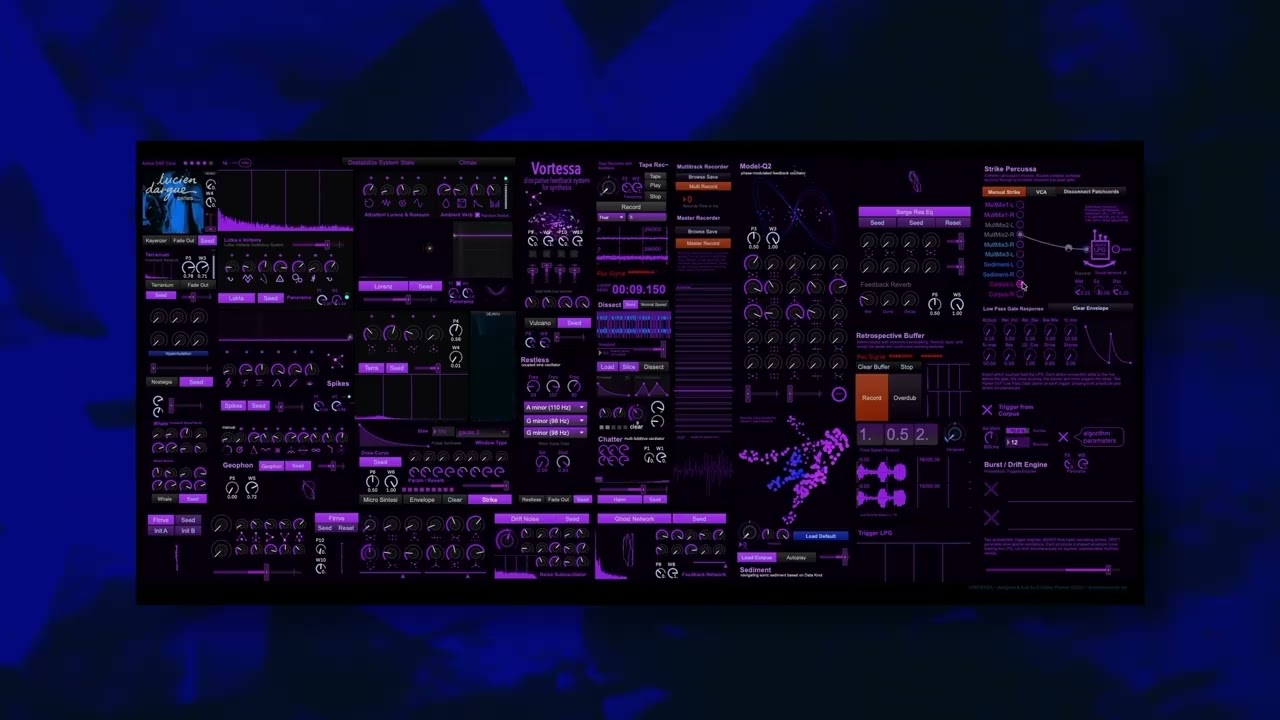
Watch on YouTube
Vortessa 3.0 — STRIKE · Retrospective Buffer · MMG Corpus
A low pass gate physically modelled on the VTL5C3/2 vactrol.
Forty-two live sources. Every hit irreproducible.
Vortessa is a dissipative synthesis system. Its sources include Lorenz attractors generating deterministic chaos, self-modifying feedback networks, inharmonic oscillators, FM structures with recursive waveshaping, shimmer reverb, ghost networks. These are not simple oscillators — they are sound ecosystems in continuous evolution, always alive, always in motion.
When not triggered by a gate, many of them continue to exist in open-gate mode, producing streams of constantly mutating sonic material. STRIKE was built to send that material through a physically modelled vactrol — and to ask what happens when it gets there.
For years I studied analogue low pass gates. Not as theoretical curiosity — I spent hundreds of hours benchmarking the gates in the studio, analysing their timbric response, understanding what makes that sound organic: the way it opens and closes like a biological diaphragm.
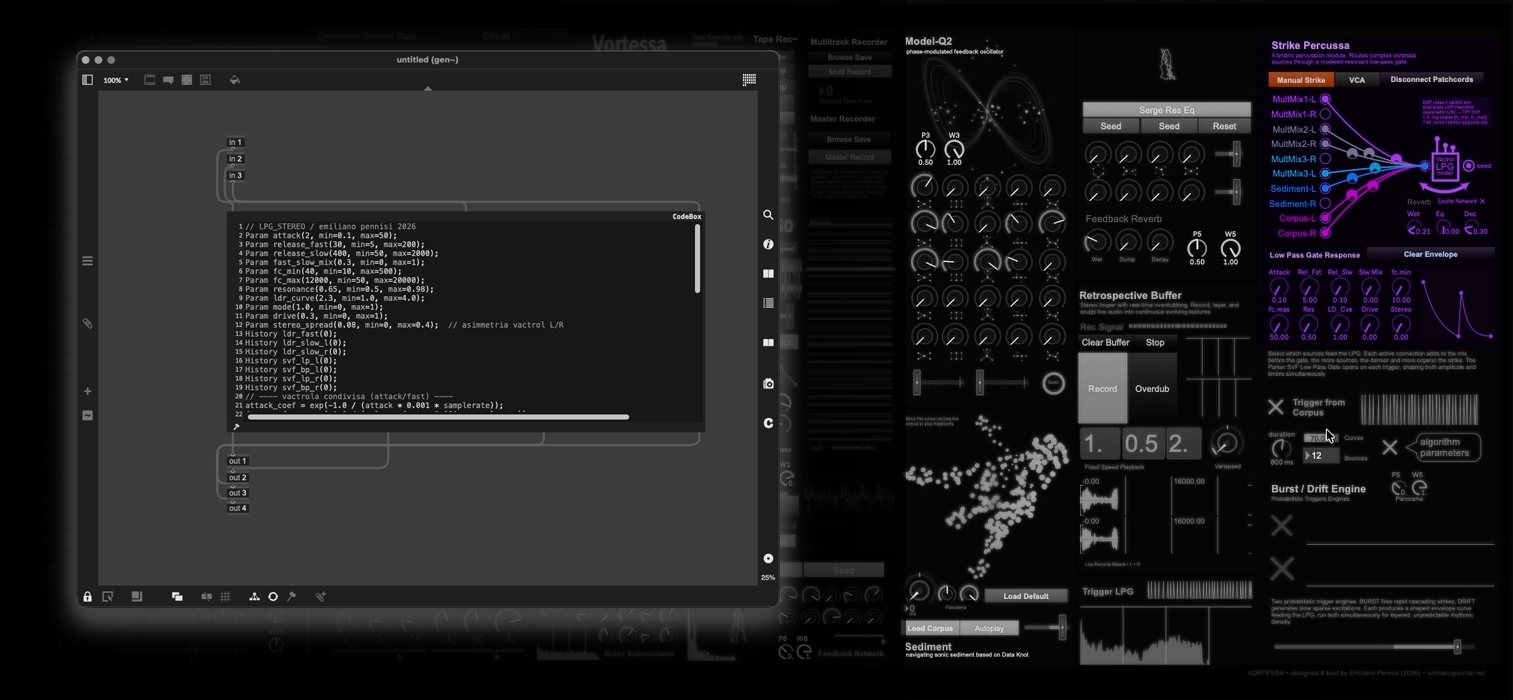
The low pass gate at the heart of STRIKE is implemented in gen~, Max/MSP's sample-level DSP compiler. The vactrol physical model follows the Parker & D'Angelo DAFx 2013 equations, with the attack time constant dynamically modulated by the current vactrol value itself — exactly as a real VTL5C3/2 behaves: the more open the vactrol already is, the faster it responds to the next excitation. Release follows a non-linear curve with a configurable exponent.
The filter cutoff (a 12dB/oct SVF) is modulated by the vactrol through a logarithmic scale — not linear, because human perceptual response to frequency is logarithmic, and because the physical behaviour of real optical components requires it. The result is a filter that opens and closes with the same biological asymmetry as a true analogue circuit.
The stereo asymmetry between the L and R channels — a slightly different release time constant per channel — introduces a sense of space and breath in the stereo response that no artificial panning can replicate. A critical bug discovered during development: gate values above 1.0 caused filter explosion through overflow in the pow() function. The fix required precise clipping followed by rescaling — a surgical solution that stabilised behaviour without altering the response curve.
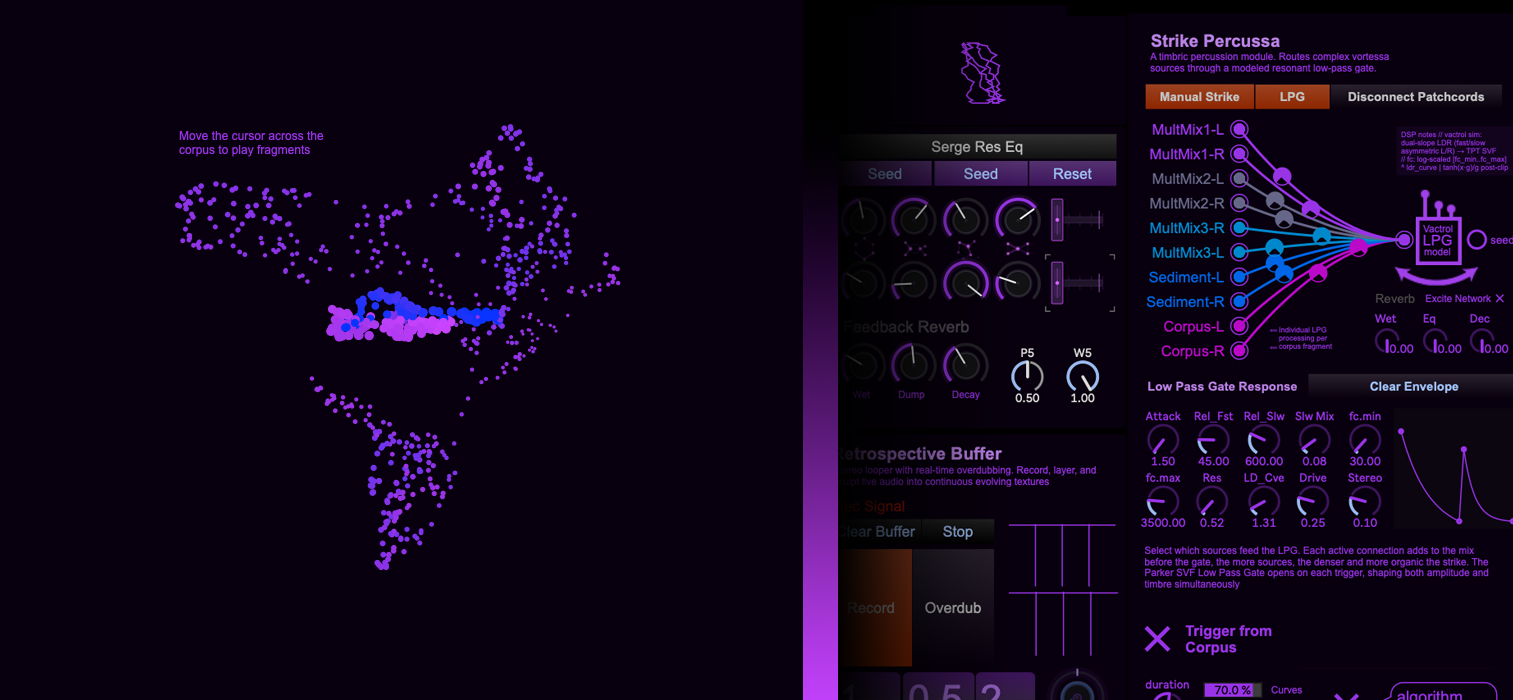
Two variants are available. LPG_STEREO uses a heuristic dual-stage vactrol — brighter, more controllable. LPG Parker SVF Stereo uses full VTL5C3/2 physics — darker, more organic. All modelling parameters are exposed in the control panel:
The integrated space — a reverb with pre-reverb EQ (Wet, EQ, Dec) — means every strike lives not only in time, but in space.
Vortessa's sources are routed into the low pass gate through a visual routing patchbay that allows any combination of sources to be connected and disconnected with complete freedom. Every active connection adds material to the mix before the gate — more sources, denser and more organic the response.
Available sources include the six stereo channels of the multimix buses (Multimix L/R 1, 2, 3), Sediment (the FluCoMa descriptor-based corpus sampler), and Corpus — forty-two channels at the base level, plus whatever corpus is loaded. This is where the timbric complexity becomes compositional: the more complex the timbre inside an LPG, the more organic the response, exactly as with sounds that exist in nature.
The parameters change while you play, reacting to the parameters of other modules, carrying something different into the gate each time. This level of timbric exploration is the territory STRIKE was built for.
Sediment is Vortessa's corpus sampler, built on FluCoMa and Rodrigo Costanzo's Data Knot. It indexes vast audio corpora through spectral descriptors and navigates them non-linearly. When routed into STRIKE, something unusual occurs: each corpus fragment — selected for spectral similarity, mirrored in the continuous space of descriptors — becomes simultaneously audio source and trigger for the low pass gate.
The fragment enters the gate, excites it, the gate opens, and the fragment is filtered and shaped by the vactrol response. The density of Sediment's playback directly determines the density of gate excitations. With corpora loaded with concrete material, field recordings, industrial sounds, the result is a percussive system that never sounds the same — not because of a random number generator moving a parameter, but because every hit carries within itself the complexity of an entire corpus.
Two probabilistic trigger engines feed the gate independently and in complement. Running both simultaneously produces layered, unpredictable rhythmic structures that no linear sequencer could generate.
Vortessa v3.0 introduces a stereo Retrospective Buffer — a system-wide sampler that runs across the entire ecosystem, independent of STRIKE. Alongside the existing tape-modelled sampler, the Retrospective Buffer captures any nuance from any point in Vortessa's signal chain in circular, continuous fashion: material accumulates layer on layer, each pass exactly superimposed on the previous one.
The blend parameter controls the crossfade between new and existing material. Around the midpoint, layers emerge and dissolve as the buffer rotates — a gradual stratification rather than a hard loop. It is not a conventional looper. It is a space where the system's memory accumulates and transforms over time.
Those working with hardware modules and analogue low pass gates will find in Vortessa the ideal sources to route into their chains. The stereo outputs can be directed to any external analogue gate — the material Vortessa generates, with its density and continuous evolution, is exactly the type of source that transforms a hardware gate from instrument to ecosystem.
An LPG that has never heard anything like it will respond in ways no conventional oscillator could provoke.
Every hit of STRIKE is unrepeatable. Not because a random number generator is moving a parameter, but because the sources are complex systems with their own memory, because the gate responds non-linearly to excitation, because the feedback networks in Vortessa react to every trigger by modifying the material they will produce at the next one. The density of the routing — how many sources enter the gate, in what proportion, with what envelope — becomes the primary compositional parameter. Vortessa enters with STRIKE a territory that music software had not yet explored.
Vortessa is a contemporary noise machine built on mathematics — approximately thirty modules including Terrarium (Lorenz attractor), Di Kaynzer, Sediment (corpus sampler), Ghost Network, Dissect, and the full LPG suite. STRIKE routes any combination of these sources through the physically modelled vactrol engine. Purchasing Vortessa includes all current and future modules.
Explore Vortessa →Included with Vortessa update 3, the MMG corpus is a collection of 509 stereo samples recorded through reamp sessions with high-quality microphones — routing diverse sound sources through analogue low pass gates and feeding the results directly into STRIKE's corpus engine.
The MMG corpus was captured through a reamp process using high-quality microphones, feeding multiple sound sources through a Make Noise MMG, QMMG, and Natural Gate, alongside a Doepfer A-101-2. Each module brings a distinct vactrol topology to the signal — from the MMG's immediate, snappy response to the A-101-2's slower, more characterful decay. The result is a library of gestural percussive hits that carry the physical signature of each gate: the weight of the vactrol, the room, the source material.
Every sample in MMG is the result of a physical gesture — a routed excitation passing through an analogue circuit with a real vactrol at its core. There is no quantisation, no velocity curve, no programmed pattern. The irregularity is the content.
When fed into STRIKE's corpus engine, these samples become the raw material for a percussion system that already contains everything an electronic score could need: attack character, timbral density, spatial width, and the peculiar silence that follows a vactrol release.
Recorded for musique concrète, the MMG corpus is equally at home in deconstructed grime, industrial, noise, and experimental electronic production. The samples sit in the frequency range where LPG-processed material lives — predominantly low-mid centroid, with enough spectral flatness to interact fluidly with tonal material without competing with it.