Lucien Dargue Series — Dissipative Synthesis

Vortessa®

Max / MSP  ·  Full Synthesis  ·  Nonlinear Generative System
A contemporary noise machine built on mathematics.
Chaotic attractors, feedback networks, unstable percussion.
Scroll
Before you read, listen first

Hear the timbre of the instrument

This is a single snapshot of Vortessa's output one of thousands of variations the system generates through its chaotic attractor and feedback network architecture. No two runs are identical. The file is intentionally delivered in uncompressed WAV format to preserve every detail of the synthesis. For the full experience, use studio monitors or high-quality headphones.

Vortessa — Demo Sound 1 · RAW WAV
0:00
Vortessa — Demo Sound 2 · RAW WAV
0:00
Uncompressed WAV · full fidelity Two variations of infinite possible outputs Best on monitors or headphones
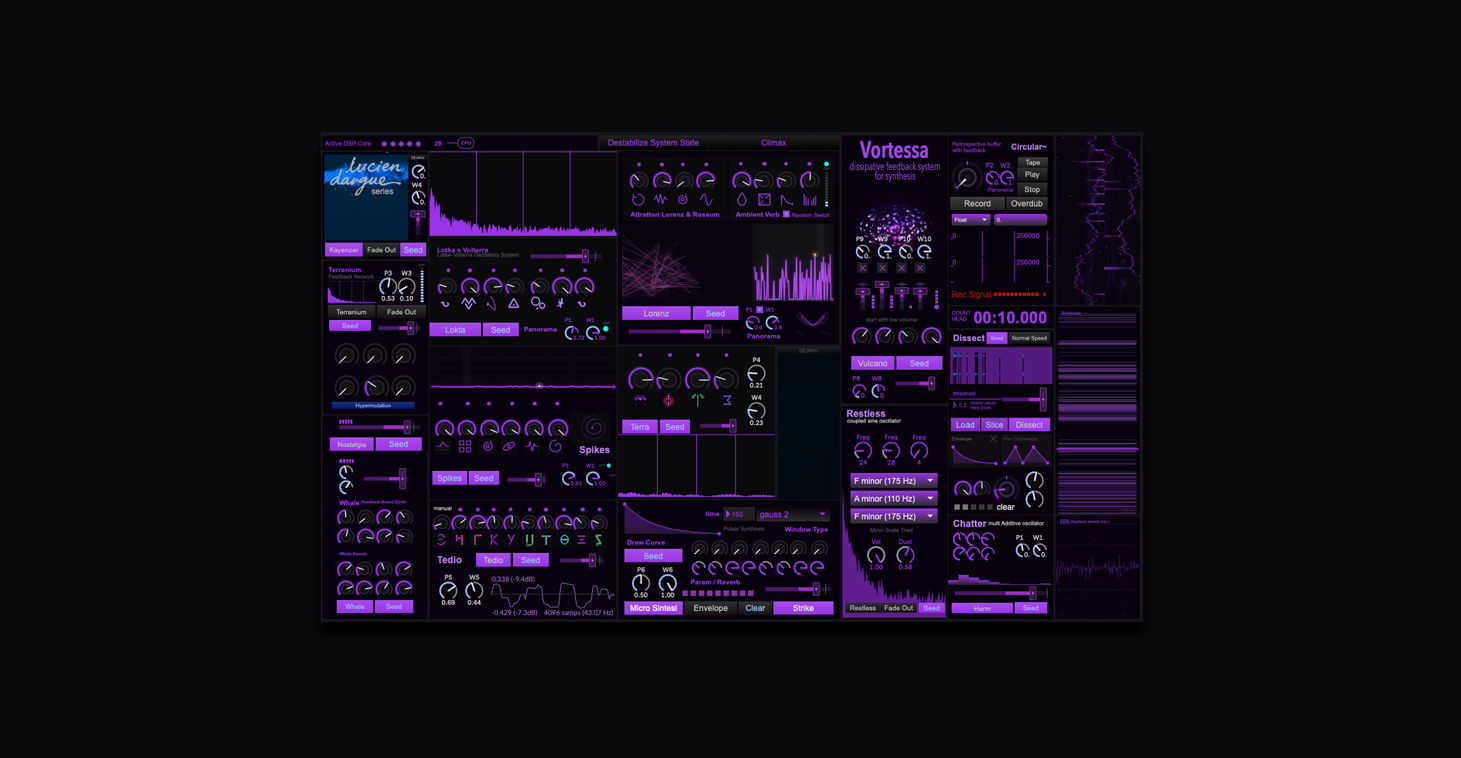
Vortessa compact GUI

Vortessa — compact interface

System

A generative system that builds its own behaviour

Vortessa is a full synthesis generative environment built around one principle: sound is not programmed, it emerges. Internal relationships between modules, not fixed sequences, determine what you hear. The synthesis core is entirely sample-free, Dissect, the corpus sampler module, extends the system into your own recorded material.

The system generates unstable percussions, glitch, drone, and ambient soundscapes. Behind this behaviour is mathematics: differential equations, chaotic attractors, dissipative dynamics. Vortessa models the sonic behaviour of impossible materials structures that exist only in the space between order and collapse.

26
Core
Modules
No two runs
identical
0
Sample-free
synthesis core
gen~
DSP Core
Max/MSP
The most extensive and articulated system I've developed so far. A nonlinear environment that builds sonic behaviour through internal relationships rather than fixed sequences.
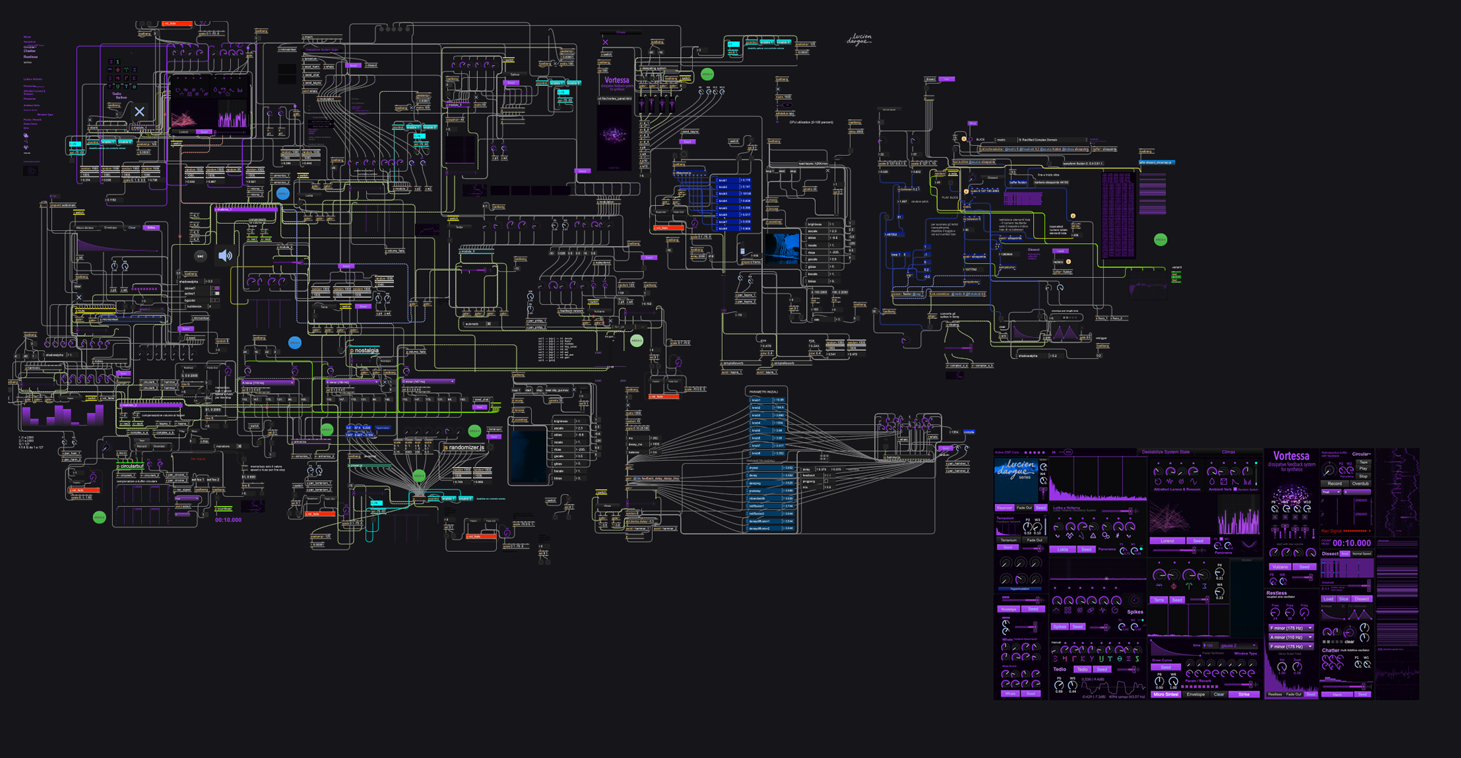
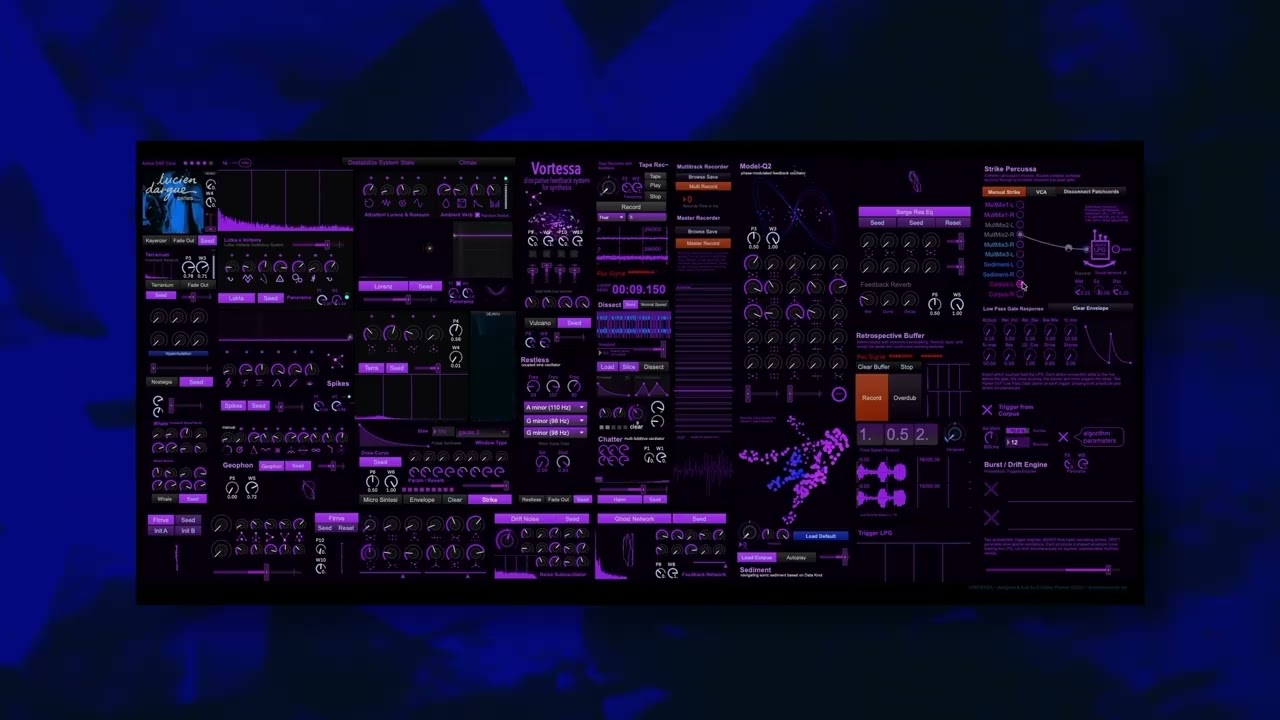
Vortessa full patch

Vortessa \full patch architecture

Modules

26 engines.
One dissipative network.

Each module is an autonomous subsystem. They do not communicate through parameter automation. They communicate through signal. The behaviour of one becomes the excitation condition of another.

Terrarium

A Lorenz attractor cross-modulated by a Rössler-type function driving 8 sine oscillators with burst/pause event logic. The attractor's state space directly controls oscillator relationships not as LFO modulation, but as a true chaotic system running at sample rate.

Di Kaynzer

Inspired by the radical network approach of Roland Kayn. Builds dense sonic structures through inter-signal relationships where no single source dominates — sound is produced by the network as a whole, from within, continuously.

Hammer

A percussive engine designed around unstable resonance. Generates attacks that are simultaneously controlled and unpredictable — impact events shaped by internal feedback rather than envelope generators. Future drums live here.

Vink Feedback Network

A custom feedback topology in gen~ codebox referencing Jaap Vink's research into feedback network composition. Signals circulate, accumulate, bifurcate. Dense accumulations and near-silence are equally valid states of the system.

Circular Looper

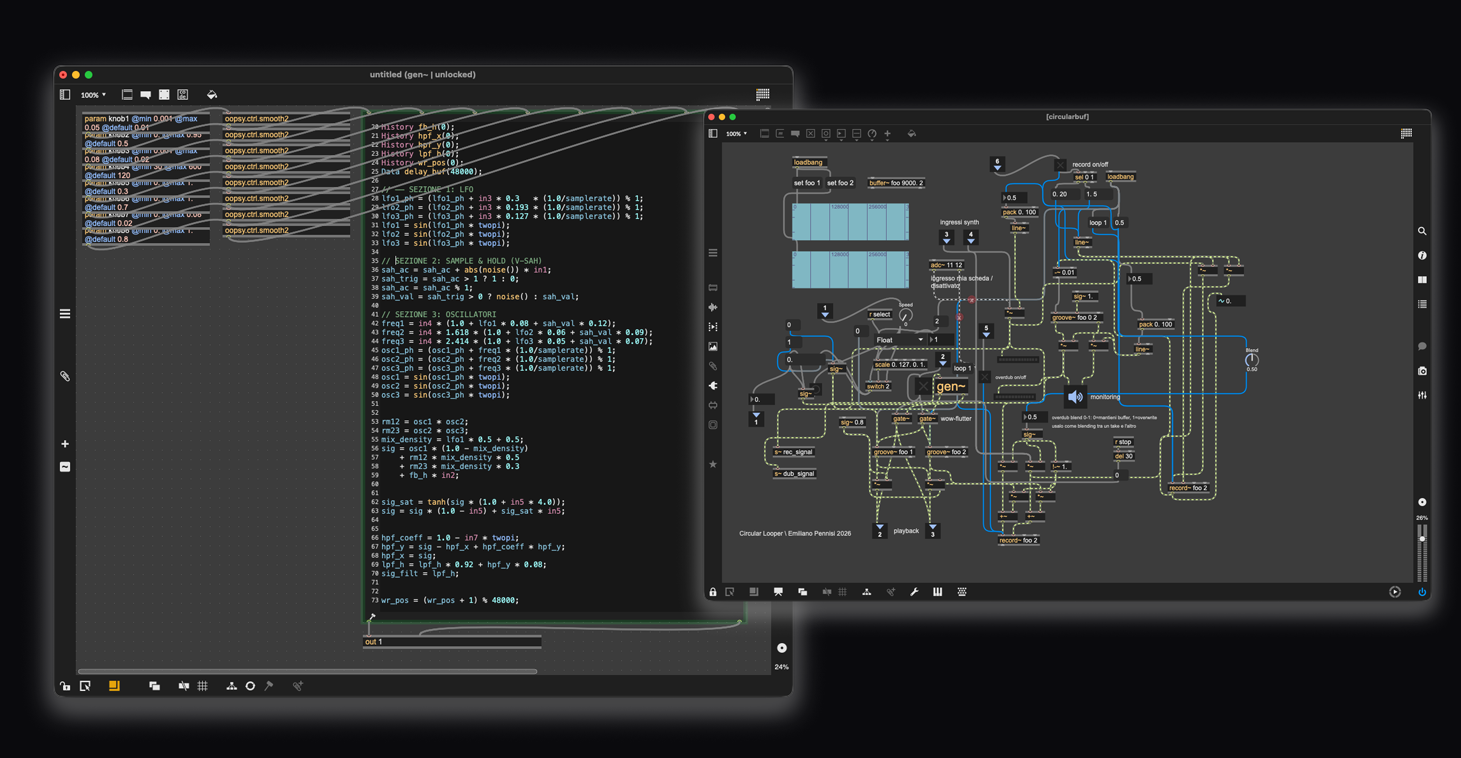
A stereo circular buffer looper built around groove~ and record~ with overdub, variable playback speed, and blend control. Overdub blend (0–1) lets you layer takes continuously — 0 preserves the buffer, 1 overwrites it. Captures any signal from the network and feeds it back into the generative chain, creating recursive material that evolves with each pass.

Vortessa expansion module\ corpus sampler
Dissect

A Corpus-based sampler in the system. It analyzes an audio buffer via onset detection and extracts slice markers, which are then navigated and retriggered at variable speed, turning any recorded material into a self-consuming, fragmentary playback engine. Alongside the circular looper, the multichannel multitrack recording system, and the master track recorder.

Get it
A note on approach

Explore slowly. The system rewards patience.

Vortessa like all systems in this series reveals its behaviour gradually. The most interesting states do not appear immediately. They emerge over time, as the internal relationships between modules stabilise, drift, and reorganise themselves. Do not rush this process.

A common mistake is activating all modules simultaneously from the start. This is the wrong approach. The combined output of 26 engines running at once will likely overwhelm your perception before you have had the chance to understand what any single one is doing. Start with one module. Listen to it alone. Learn its character, its range, its tendencies. Then introduce a second. Build the system incrementally.

Terrarium is a natural starting point its Lorenz attractor produces structured yet unpredictable behaviour that makes the underlying logic of the system audible. Spend time here before moving on.

With Di Kaynzer, the approach is different: use the randomisation seed. Roll the dice repeatedly each new seed reconfigures the internal network relationships and produces a different feedback behaviour. Do not judge a single result. Listen across multiple seeds until you begin to recognise the character of each configuration. The right seed at the right moment can open a behaviour you could not have composed deliberately.

In general: fewer simultaneous modules, more time per state, less intervention. The system is capable of evolving on its own in ways that will surprise you but only if you give it the space to do so. Moderation of gesture is not a limitation. It is the technique.

Mathematics & Dissipation

Systems far from
equilibrium

Chaotic Attractors

In Vortessa's core module, the Lorenz attractor is implemented as a real chaotic system at sample-rate resolution inside gen~. The Rössler function reads the position of the Lorenz trajectory and writes values into a matrix, influencing parameters in a nonlinear way. The attractor's position in phase space directly shapes the 8 oscillators beneath it. This is not LFO-rate modulation. It is a living geometric object whose trajectory becomes sound.

Bifurcation and Dissipative Structures

Prigogine's work describes systems that self-organize into new patterns when pushed past critical points far from equilibrium, producing structure through instability. When feedback crosses certain thresholds inside the network, the system reaches a bifurcation point. What emerges depends on internal noise, delay fluctuations, stochastic modulation not user input. Two identical configurations produce radically different trajectories. This is not a limitation. It is the mechanism.

The Vink Feedback Network

Jaap Vink's compositional practice treats feedback networks not as effects but as generative organisms. Signals circulate through a topology of mutual influence, where each path's output becomes another path's excitation. The Vink Feedback Network in Vortessa applies this in gen~: a closed loop where no single node is the source. Sound is produced by the network as a whole.

A contemporary noise machine that models the behavior of impossible materials. Unstable, self-organizing, nonlinear designed to produce sound that could not be achieved any other way.
Listen

The system in motion

These recordings capture only a fraction of what Vortessa is capable of micro-events, glitch percussions, dense drone accumulations, cinematic ambience.

Vortessa — Official Playlist
Watch playlist on YouTube →

Official Vortessa playlist \ new sessions added regularly

Vortessa detail

Vortessa \ some code details

Stem Recording

Capture every layer.
Up to 40 mono stems.

Vortessa includes a dedicated multitrack recording system. The two mixer blocks multimix_1 and multimix_2 each run a 20-channel MC bus. Both record simultaneously to two multicanale files, which are then split into individual mono stems via a companion ffmpeg script included in the package.

The script is smart: it measures the RMS level of each channel and automatically skips silent ones. If you only had 8 modules active during your session, you get 8 stems not 40 empty files.

40
Mono stems
maximum
MC
Multichannel
bus routing
JS
Real-time
pan/width engine
DAW
Session-ready
multitrack

How it works

The MC mixer receives all module outputs as a 20-channel stream. Each channel has its own pan knob and stereo width control. a JS function computes left/right gain values in real time using equal-power summing, firing them into the MC chain via mc.target messages one pass per parameter change, no polling.

Pre-panning recording — full mix control

Stems are recorded pre-panning — the 20-channel bus is tapped before the panmath engine applies spatial positioning. You receive each module's raw signal with complete freedom to position, process, and mix it in your DAW exactly as you want.

Stereo master recorder

A second recorder captures the stereo master output — the full mix with Vortessa's pan law already applied, directly usable without any post-processing. Choose one before recording: 20 mono stems for full DAW control, or a single stereo file ready to use.

Spatialization as architecture

The pan/width system is not a mixer. It is part of how Vortessa constructs its sonic output. Each module operates through a paired L/R logic: a pan position and a stereo width value are combined to compute the gain of each channel independently. The underlying math handled in real time by the js function distributes the signal across the stereo field as a continuous function, not a static position.

This means that the spatial configuration of a session directly affects how the frequency content is perceived. Wide configurations spread resonant partials across the field, separating overtones that would otherwise mask each other in a narrow or mono sum. Narrow configurations collapse the field into a denser, more opaque mass. Width and position are not decorative — they are part of the instrument's capacity to generate perceptually complex, spectrally rich material from a relatively small number of simultaneous sources.

Each source generates a dynamic stereo distribution routed into the multichannel buses — spatialization is not applied after the fact, it is built into the signal path from the point of generation.

Split script ~ macOS & Windows

The package includes vortessa_split.sh (macOS) and vortessa_split.bat (Windows). Both require ffmpeg, which is free and installs in under two minutes. Full setup instructions, alternative methods, and troubleshooting are in the included guide.

The system never plays the same session twice. Recording is not optional it is the only way to keep what happened.
Origin — hardware benchmark

Before Vortessa, there was the Daisy.

The feedback agents that now run at the core of Vortessa were first benchmarked on the Electro-Smith Daisy embedded platform — a programmable DSP environment that runs entirely outside the computer, with no operating system overhead. The goal was to stress-test the feedback architecture under severe hardware constraints: limited memory, fixed clock, no safety net. What emerged from those sessions defined the timbral character of the system. The structures that survived Daisy became the structures inside Vortessa.
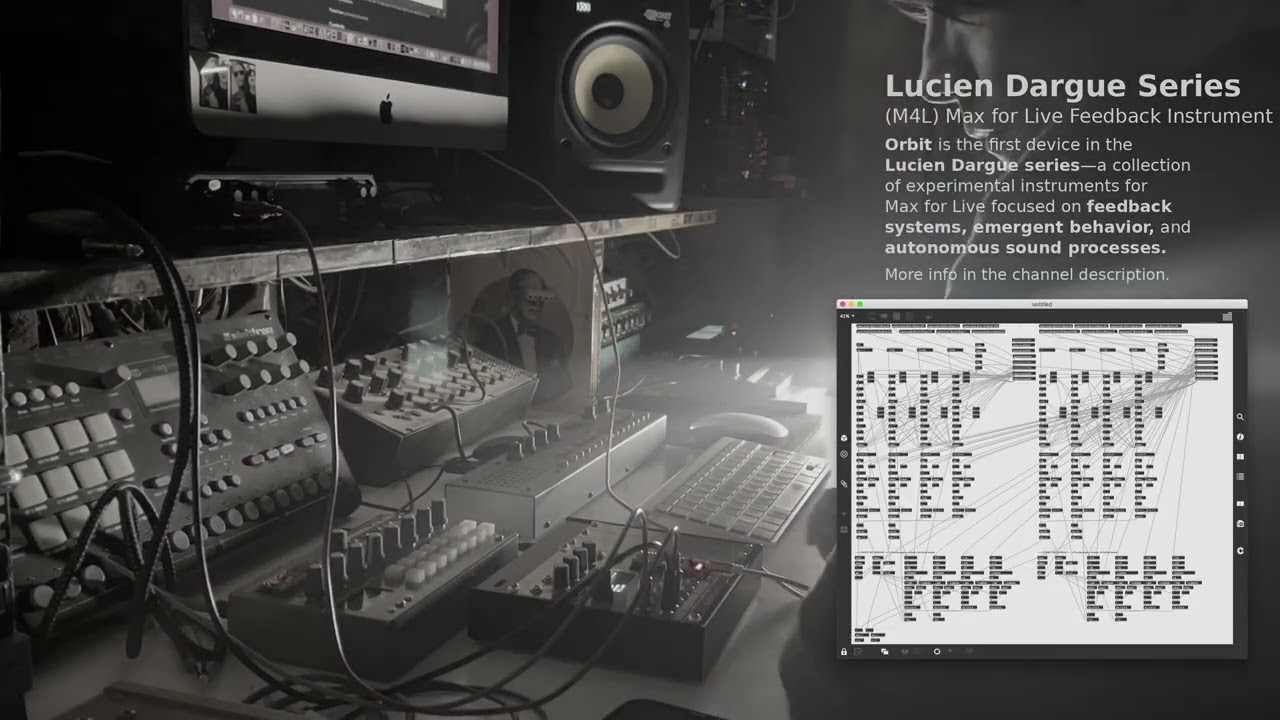
Orbit on Daisy — early benchmark

Early benchmark of Orbit's feedback agents on the Daisy platform — emergent structures under hardware constraints
Orbit — the instrument where this began →
Get Vortessa

One instrument.
Infinite configurations.

39.00
Purchase on Gumroad

Single license · Lifetime updates · No subscription

Vortessa + Orbit Bundle
Also available — Bundle

Vortessa + Orbit

If you want to explore feedback-based synthesis inside Ableton Live, this bundle pairs Vortessa with Orbit — a Max for Live device built in gen~ around unstable feedback structures, stochastic parameter networks, and internal energy regulation. Two different environments, one shared obsession: systems that evolve rather than being explicitly controlled.

Orbit runs directly inside Ableton Live as a Max for Live device. Vortessa operates as a standalone Max/MSP environment. Together they cover feedback synthesis across both contexts.

Get the bundle on Gumroad →
The Ecosystem

Other instruments
in the series

Vortessa belongs to a body of work developed under the Lucien Dargue alias. Each system operates by its own logic. They share one obsession: sound that emerges from internal relationships rather than external control.

Development context

This DSP core was first built for Orbit.

Orbit is a Max for Live device developed prior to Vortessa, built around the same feedback network architecture. The bifurcation logic, the gen~ DSP core, and the hardware benchmarking on the Electro-Smith Daisy platform were all part of that earlier development cycle. Vortessa extends the same foundation into a full standalone environment: more synthesis engines, additional mathematical layers, multichannel recording infrastructure.

Explore Orbit →