ASSEMBLY
7A polymetric algorithmic drum synthesizer. Dual DSP architecture: Max/MSP + SuperCollider via OSC. No global reset. No presets. 7 layers of organic synthesis + 2 sampling layers. Only drift and controlled instability.

How ASSEMBLY-7 Actually Behaves
ASSEMBLY-7 is not a conventional drum machine. You can program familiar sequences — for example a straight 4/4 kick pattern — but the architecture of the sequencer makes it unlikely that events will remain perfectly aligned over time. Each line runs on its own cycle length, tempo, and internal phase. As cycles accumulate, the relationships between voices slowly shift: elements that initially coincide gradually drift apart.
This behavior is not a flaw but the core principle of the machine. The sequencer is designed for rhythmic drift rather than stable repetition.
Another important aspect concerns decay and density. When decay values are extended — or when the system runs at higher speeds — individual percussive hits begin to overlap. At that point the result moves away from conventional drum patterns and becomes closer to rhythmic textures or evolving sonic surfaces.
In other words, ASSEMBLY-7 can produce recognizable patterns, but it naturally tends to transform them into more fluid and unstable structures.
By using the Random Filler with only a few active steps, adjusting step lengths across lines, and experimenting with independent BPM values, slower configurations begin to emerge — patterns that move with a slightly uneven, limping motion. From this interaction arises one of the most interesting qualities of the instrument: a natural groove.
This groove is not produced by programmed swing or quantization. It emerges from the interaction between independent cycles and phase drift across the system.
In this sense, ASSEMBLY-7 redefines the idea of groove: not a perfectly aligned grid, but a rhythmic geometry constantly shifting in time.
/ Architecture
ASSEMBLY-7 splits the timbral work across two DSP layers — Max/MSP handles sequencing, interface, and user experience; SuperCollider handles all synthesis. Communication between the two is entirely via OSC. The result is a machine that sounds like rusty iron.
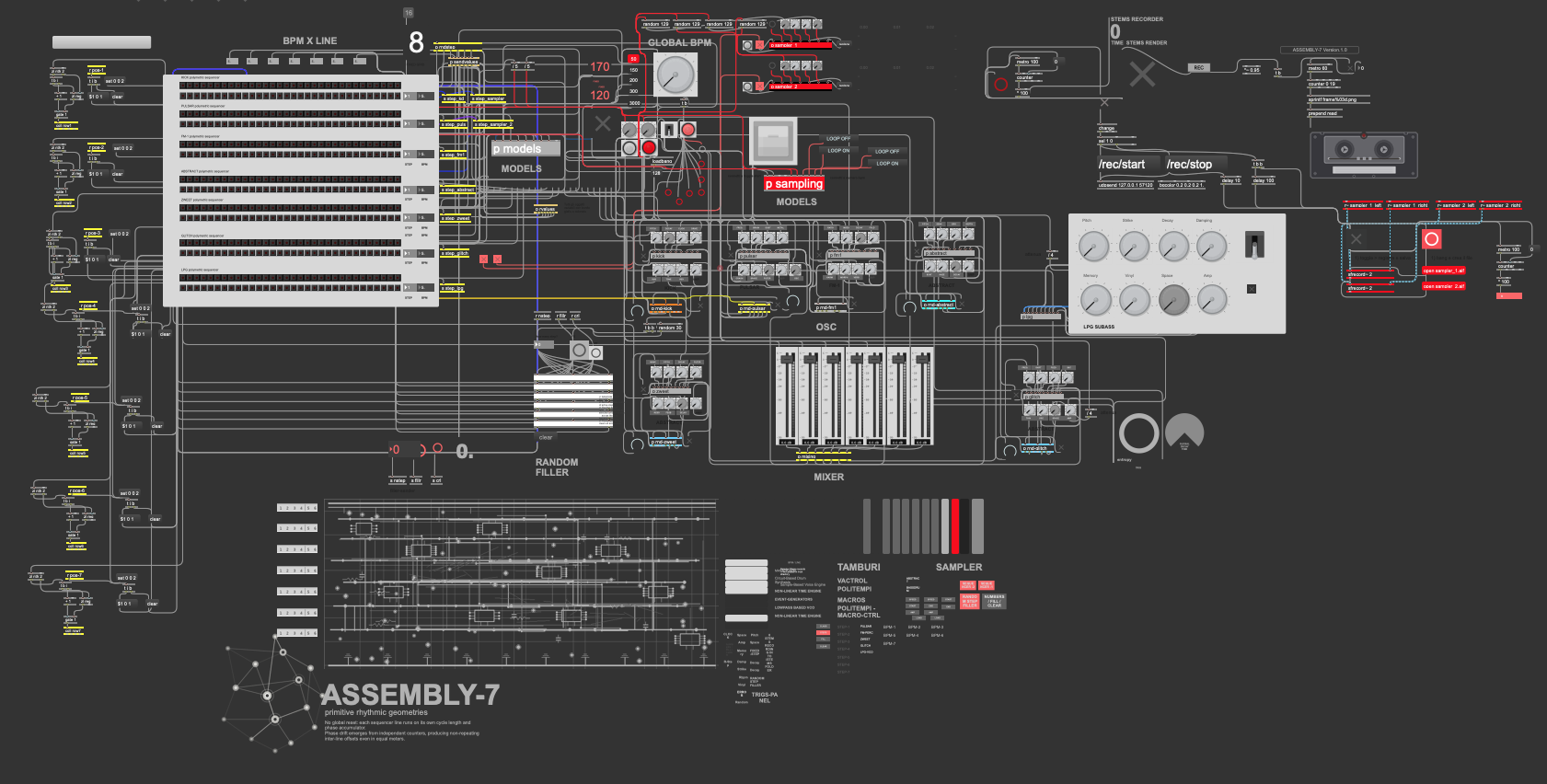
The 32-step sequencer manages each row independently: different lengths for each voice, different tempos. Kick on 16 steps, pulsar on 5, FM on 7 — continuous rhythmic shifts that never repeat in the same way. Each row runs its own metronome, synchronized to the global clock or completely free.
Step 1 of the kick no longer falls together with step 1 of the pulsar after the first cycle. The rhythmic structure emerges and dissolves. This is not a traditional step sequencer. It's a tension-driven rhythmic engine.
/ Engines
7 algorithmic percussive synthesis voices operating in a polymetric environment with a variable grid. The synthesis engines can be completely reconfigured through custom Engine files (SuperCollider-based). These are not simple presets — each Engine restructures the internal sonic architecture of the machine, changing its timbral identity at a deep level.
The spectrum ranges from dry industrial percussion to granular fog, from recursive IDM distortion to inharmonic FM synthesis with feedback. 8 real-time parameters per voice. No samples in the synthesis section — only synthesis.
By extending the decay, the percussive sound transforms into texture — oxidized metallic surfaces, grains accumulating, FM collapsing into drone. Each trigger does not produce a hit but opens a window onto an ongoing timbral process.
/ Auto-Velocity — Dynamic Articulation
Although steps in the sequencer may appear programmed with the same velocity, the system continuously reshapes the actual dynamics of each hit. Over time, every voice develops its own micro-variations in amplitude and articulation. The resulting behavior is highly dynamic, as if the pattern were performed by a human rather than triggered by a rigid machine.
This happens because several synthesis parameters internally introduce controlled random fluctuations. These variations subtly affect energy, transient response, and decay, so each repetition of the same step is never exactly identical. The result is a constantly evolving dynamic field rather than a static sequence.
Watch how the dynamic articulation shapes the rhythmic output in real time. Engine #4 is used throughout this demonstration.
Watch on YouTube →/ Sampling Layers
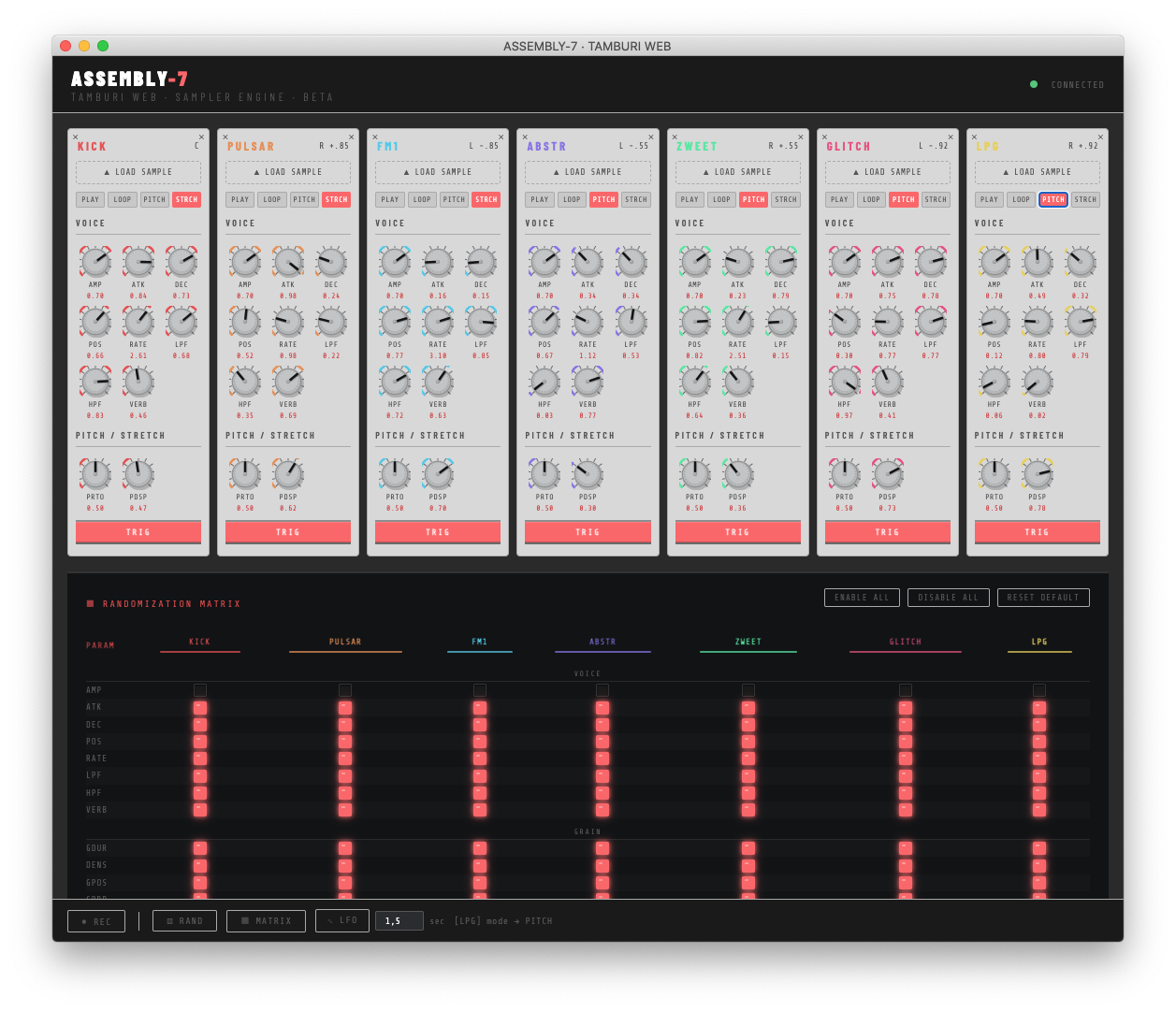
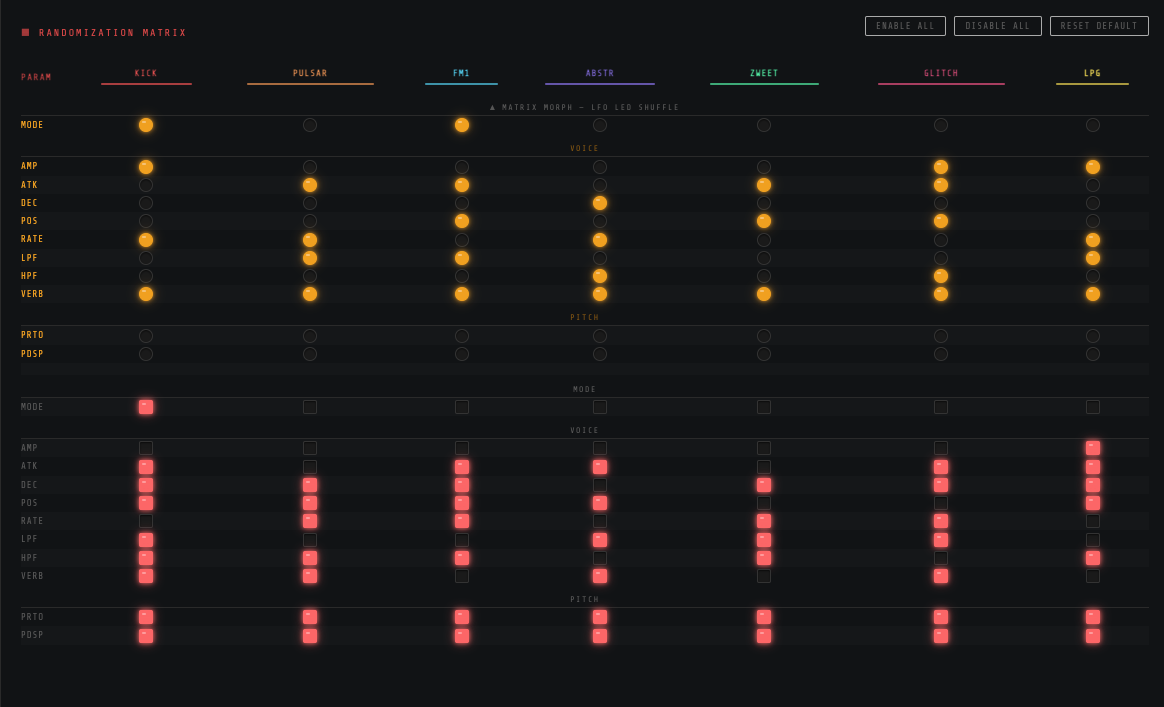
Originally built around 7 drum synthesis engines, the machine now includes two fully integrated sampling layers: Sampler 1 and Sampler 2. Load your own audio files, articulate them via the internal sequencer, integrate them with drift and polymetric logic. Turn any sound into structural rhythmic material.
/ Stem Recording
ASSEMBLY-7 can record in a single pass:
/ Sequencer
A polymetric system with no global reset: each line runs on its own cycle length and phase accumulator. Phase drift emerges from independent counters, producing non-repeating inter-line offsets even in equal meters.
The panel is freely inspired by the Doepfer A-157 Trigger Sequencer, including the knob design which references classic Doepfer aesthetics. Custom GUI built entirely with JavaScript for Max/MSP. While the interface may recall the layout of traditional drum machines, the internal behavior is far from conventional — the rhythmic logic operates in ways rarely seen in drum machines.
/ Lineage
The sonic reference behind this approach goes back to Het Zweet — Marien van Oers, who passed away many years ago. If you already appreciate Muslimgauze, it is worth exploring that work as well. I also have the honour of being on the same label, Heat Crimes, where an anthology was released.
Het Zweet occupies a territory where industrial rhythm, tape deterioration and obsessive repetition collapse into something that barely holds together — primitive drum patterns recorded through layers of distortion, hiss and overdriven signal chains. The sound is intentionally degraded, intentionally wrong.
Muslimgauze pushed a parallel idea even further: rhythm as geography, percussion as political landscape. Layers of hand drums, distorted loops and relentless polyrhythmic stacking that refuse resolution. Both operated outside genre boundaries, treating the drum machine not as a tool for groove but as a generator of tension and structural instability.
ASSEMBLY-7 lives in that territory. Its sound is raw and unstable, more aggressive than the Noise Engineering modules I own. If you are drawn to the territory of Throbbing Gristle, take a look.
On offbeat
The background behind this approach comes from club music and drum machines. Over time the focus shifted toward rhythmic displacement rather than genre labels. Offbeat is not a style — it is a structural decision: shifting accents inside the bar changes the entire movement of a groove. Offbeat has always existed in music, from reggae to funk to jazz, and in electronic club music it is almost a constant.
Years of working with modular sequencers such as Teletype and Ornament & Crime opened a significant path in that direction. Assembly-7 emerged from that exploration.
The behavior is highly non-linear like in the Endogen logic — the system is moving in that direction. Patterns move, overlap, misalign.
/ Specifications
▶ Watch & Listen
The official YouTube playlist documents the entire development of ASSEMBLY-7 — from the earliest prototypes to the latest sampling integration. Hear the timbral evolution, see the sequencer in action, watch stem recording and Ableton export workflows.
Official Playlist on YouTube →The Ecosystem
ASSEMBLY-7 is part of a coherent suite of tools for deep sonic exploration. Each addresses a different relationship between composer and sound material.
Endogen
Lowercase, microsound & drone synthesis environment. 30+ modules, corpus explorer, cybernetic feedback systems. Max/MSP + SuperCollider.
Envion
Procedural ecosystem for algorithmic composition and musique concrète. Envelope-first logic — sound articulated through ternary envelopes, not notes. PureData & Max MSP.
Interfera
Geosonic field recordings engine. Streams from Radio Aporee, Internet Archive & Freesound. Convolution processing. Sound excavated from geographic coordinates.
Together: neither purely authored nor purely found — somewhere between composition and excavation.
/ System Requirements & Setup
ASSEMBLY-7 is a Max/MSP patch. It is not a standalone application, not a VST plugin, not an AU plugin, and not a Max for Live device. It cannot be loaded inside Ableton Live as an instrument or effect.
If you own Ableton Live Suite (which includes Max for Live), you already have Max/MSP installed on your system. However, ASSEMBLY-7 must be opened directly in Max/MSP — it does not run inside Ableton Live.
ASSEMBLY-7 runs on both macOS and Windows. Both Max/MSP and SuperCollider are available for both platforms.
No special installation is required beyond Max/MSP and SuperCollider. The setup is identical to the other tools in the same ecosystem: Endogen, Envion, and Interfera.
ASSEMBLY-7 uses a dual DSP architecture. Max/MSP handles the sequencer, interface and user experience. SuperCollider handles all sound synthesis. The two systems communicate via OSC (Open Sound Control).
Max/MSP manages the sequencer and interface. SuperCollider manages the synthesis. Once both are running, the machine is fully operational.
ASSEMBLY-7 is designed as a generative drum machine for producing rhythmic material. The typical workflow is: play the machine, generate material, record the stems. The recorded files — master stereo, 7 synthesis stems, and 2 sampler stems — can then be imported into any DAW or production environment for further processing, mixing, and arrangement.
In practice, ASSEMBLY-7 is a material generator. It produces the raw rhythmic content that you then work with elsewhere.
Get ASSEMBLY-7
€39 €49
Launch promo — calculating…