Brain Recordings — Concrete Music Machines
Concrete
Music
Machines

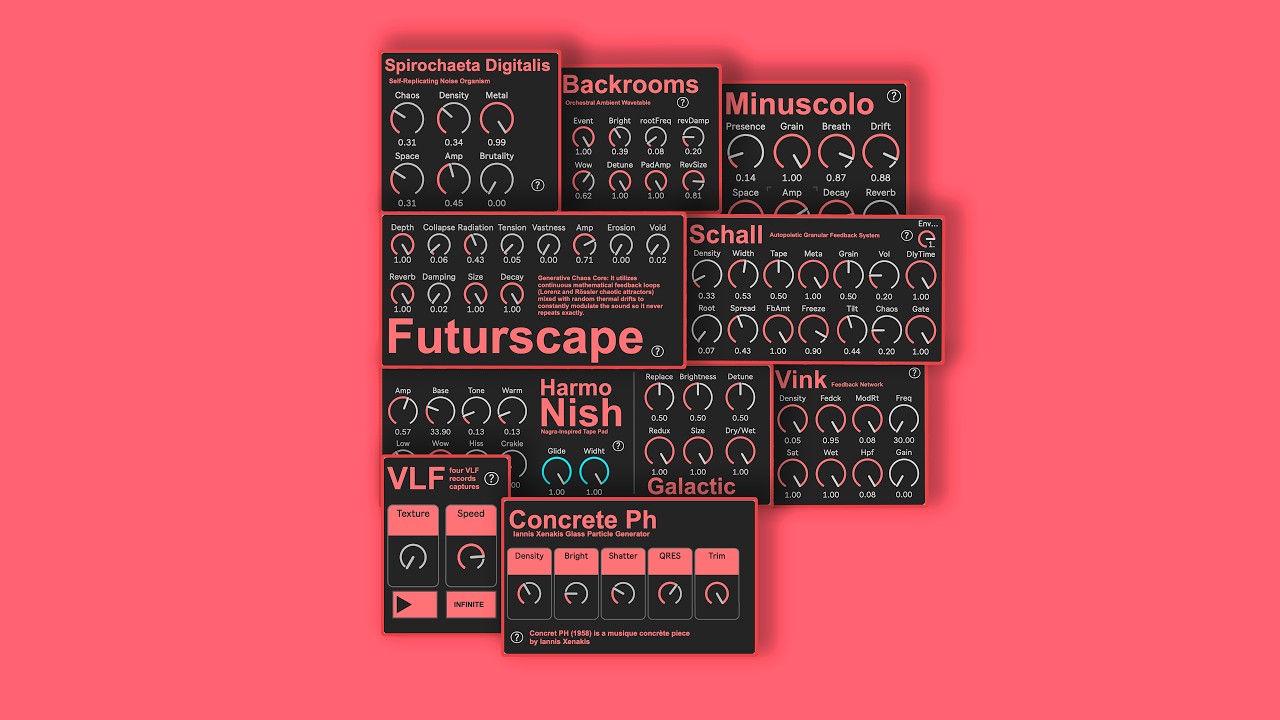
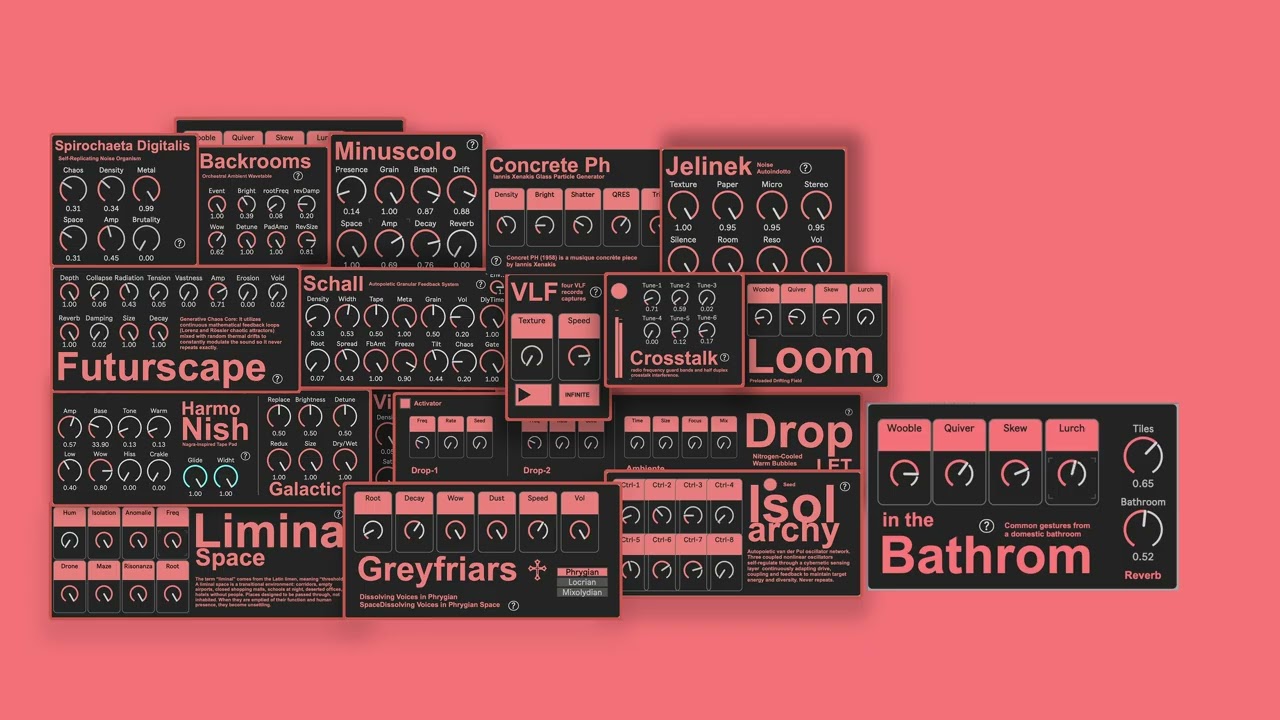
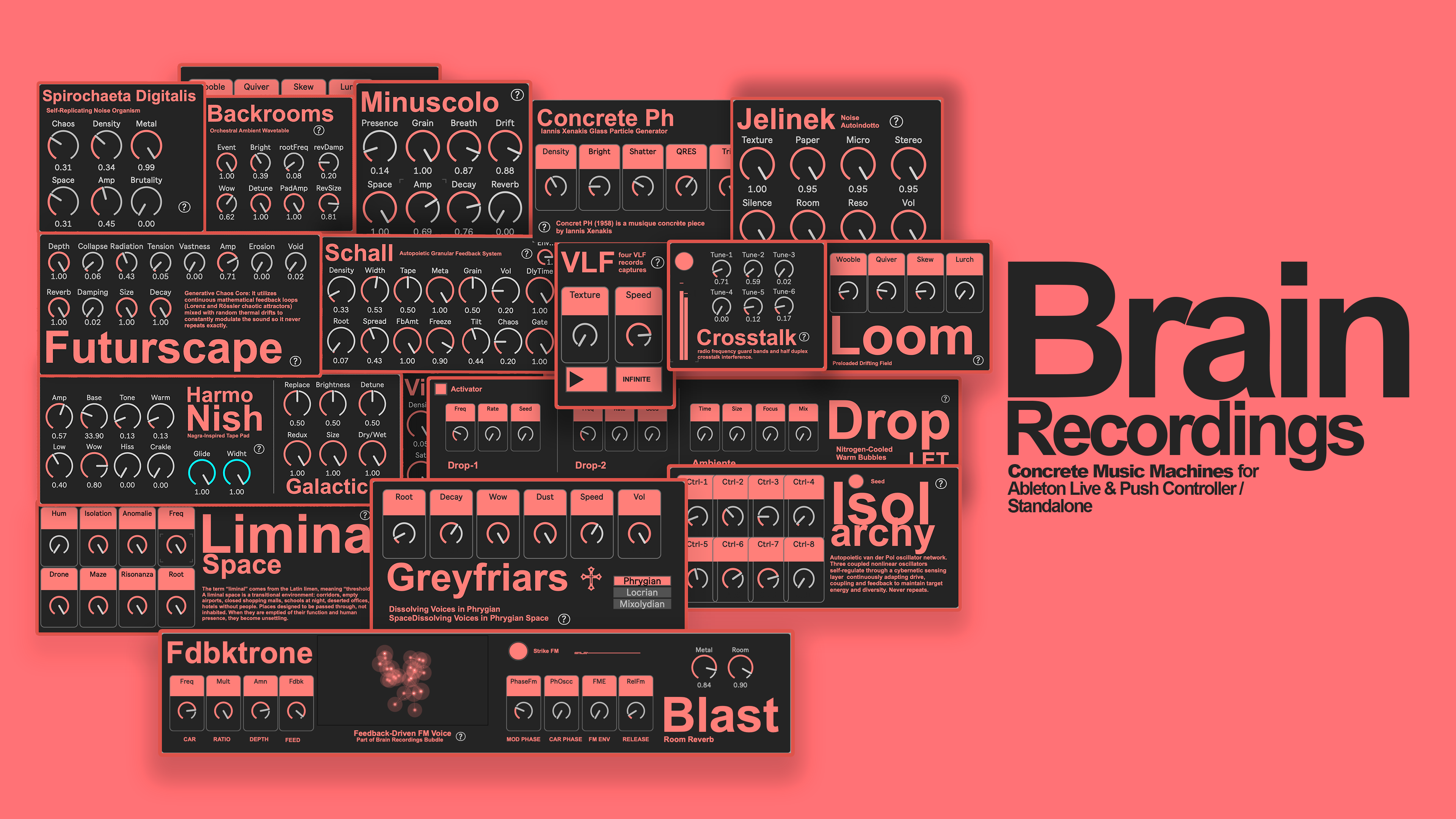
Brain Recordings is a bundle of 17 Max for Live devices for Ableton Push Controller and Push 3 Standalone, built for the practice of musique concrète, microsound, lowercase, and dissipative synthesis. And there is a surprise hidden inside.

Each machine operates as a self-contained sound ecosystem: feedback networks, chaotic attractors, granular textures, physical models, electromagnetic captures, and spectral interference, all mapped directly to Push's encoders for immediate, tactile control.

From the glass particle generator of Concrete Ph, a direct reference to Iannis Xenakis's 1958 piece, to the Van der Pol oscillator network of Isolarchy, these instruments are designed to evolve, drift, and never repeat exactly. They are not synthesizers in a conventional sense. They are processes.

More modules are coming.

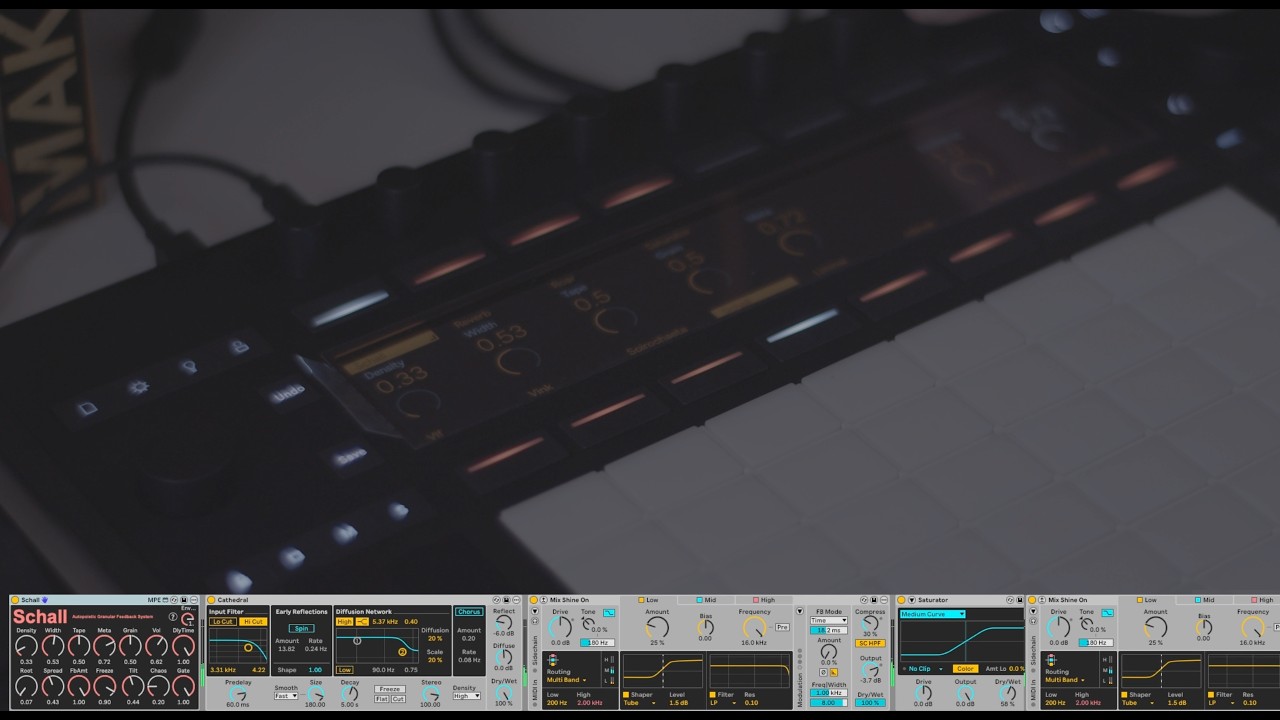
Over the last few months I've started using the first modules from a new generative system I'm building specifically for Ableton Push 3 Standalone. More than a traditional groovebox, I'm beginning to see Push as a contemporary instrument in itself — something capable of hosting unstable, autonomous and deeply performative sound systems directly inside the hardware.

I genuinely think this could become one of the first larger sets of generative soundscape and noise tools fully compatible with Push Standalone, while still working perfectly inside Ableton Live as normal Max for Live devices. The project is heavily inspired by years of listening and research around musique concrète, lowercase music, contemporary noise and self-organizing electronic systems. Steve Roden's lowercase approach, microsound structures and feedback-based environments have all been a huge influence on the direction of these modules.

The focus is not on conventional sequencing or beatmaking, but on evolving drones, unstable textures, autonomous soundscapes and generative processes designed around direct physical interaction with Push itself. Everything is built entirely in native gen~ with no external dependencies. Every module includes dedicated parameter banks mapped directly to the Push encoders.

I also run the Reddit community r/musiconcrete where I regularly share experimental music tips, software explorations and discussions around contemporary sound practices.

Early access
€39€49
First 10 days only
Buy on Gumroad
Compatibility
Ableton Live 12 — fully tested
Ableton Live 11 — most modules work
Drop and Isolarchy require Live 12
Push 2/3 Controller
Push 3 Standalone
Spiro­chaeta
Digitalis
Self-replicating noise organism. Lorenz attractor drives six resonant layers through recursive feedback reverb.
Spirochaeta Digitalis
Read manual →
Six resonant layers triggered stochastically and driven by a Lorenz chaotic attractor. Noise, metal, and space interact through recursive multi-buffer feedback reverb with 8-stage allpass diffusion. Chaos and brutality continuously reshape spectral density and harmonic content. The organism feeds on itself and never settles.
Back
rooms
16-oscillator wavetable pad. Companded bass, organic wow/flutter, algorithmic reverb.
Backrooms
Read manual →
16 oscillators in dual detuned pairs traverse a pentatonic scale through probabilistic event triggers. Mu-law companding on the bass register. Wow and flutter from layered slow/fast LFO drift plus microscopic noise. Four-tap reverb with allpass diffusion and variable room size. Never repeats the same harmonic configuration twice.
Minus­colo
Granular feedback texture. Four grain streams, tape drift, tilt EQ from darkness to burn.
Minuscolo
Read manual →
Four probabilistic grain streams with independent LFO modulation rates and Hann window envelopes. Grain pitch spans low sub to high-frequency scatter. Feedback from multi-tap delay network bleeds back into pitch modulation. Tilt EQ shifts spectral weight between deep low-end warmth and harsh upper-register crumble. Tape age controls saturation and delay character.
Concrete
Ph
Glass particle generator. Homage to Xenakis 1958. Stochastic excitation, four resonant bodies.
Concrete Ph
Read manual →
Direct reference to Iannis Xenakis's 1958 electroacoustic piece. Probabilistic glass particle generator: stochastic excitation triggers two independent oscillators and four resonant second-order IIR filters. Shatter density controls secondary impact probability. Brightness maps to spectral centroid of the glass mass. Asymmetric stereo diffusion.
Jelinek
Paper grain, room resonance, rare object excitation. Silence as structure.
Jelinek
Read manual →
Inspired by Jan Jelinek and the Faitiche aesthetic. Paper fold, brown noise, and microscopic fiber events triggered probabilistically through bandpass filters. Room tone from three sine oscillators at 45, 90, 135 Hz. Rare object excitation drives four physical resonators: wood, glass, and metal. Silence depth controls event density — at maximum, minutes can pass between sounds.
Futur­stage
Lorenz and Rössler drive four FM operators into six resonant noise channels. Sub below 30 Hz.
Futurstage
Read manual →
Lorenz and Rössler strange attractors simultaneously drive four FM synthesis operators and three waveshapers. Their outputs feed six cascaded resonant noise channels with cross-injection between bands. Sub-bass oscillators descend below 30 Hz with pulse modulation. Dynamic compander manages gain reduction at high energy states. A dystopian, atonal, continuously mutating soundscape.
Schall
Autopoietic granular feedback. Four grain streams, triple-tap delay, tape age saturation.
Schall
Read manual →
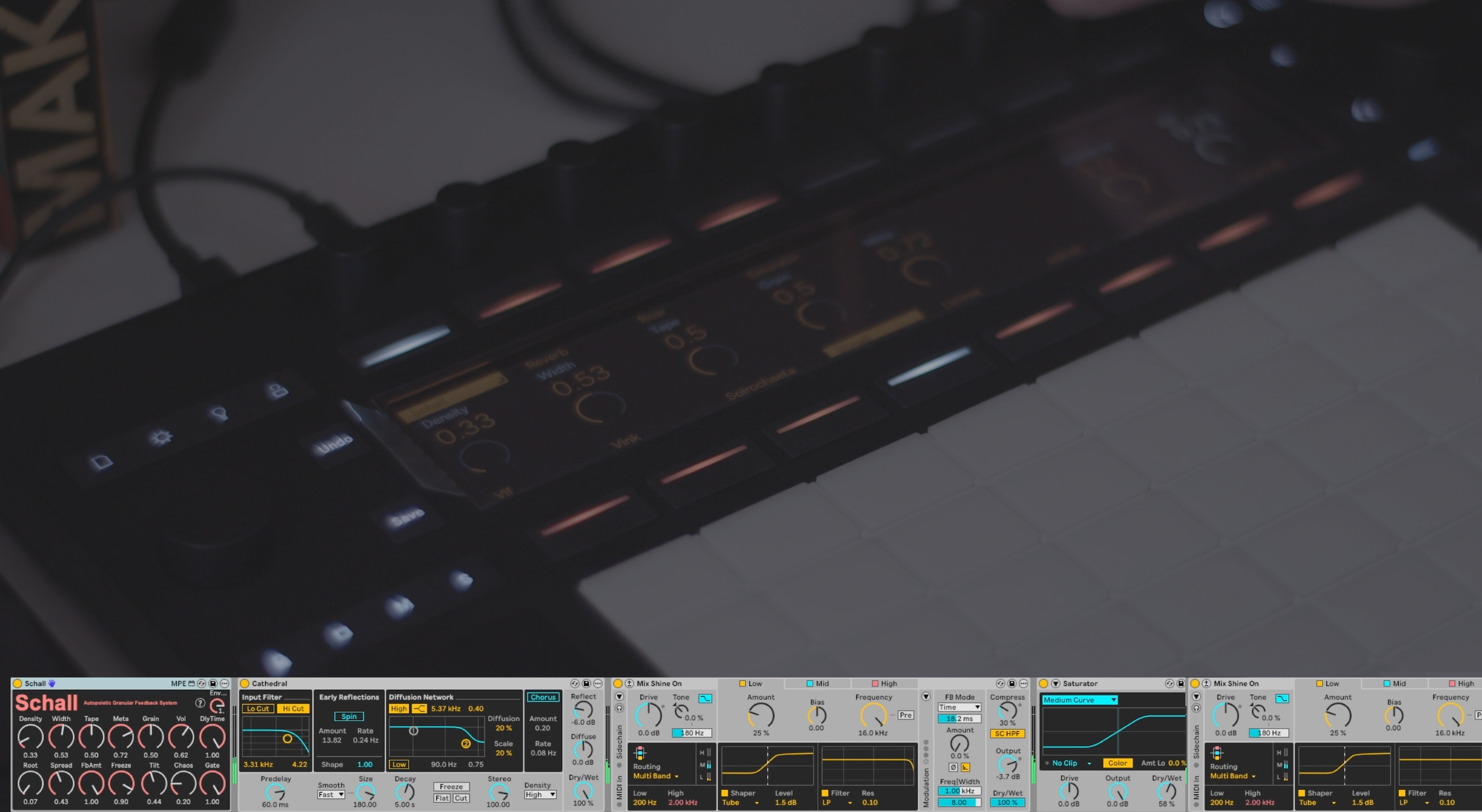
Four probabilistic grain streams with independent trigger rates modulated by asynchronous LFOs. Each grain carries a Hann envelope and contributes to a shared write pointer in a 65536-sample buffer. Three delay taps at variable times read back into the grain oscillators creating recursive spectral accumulation. Feedback amount and tape age control whether the system exhales quietly or fills with dense, saturated mass.
VLF
Four electromagnetic field recordings. Rowaves VLF receiver, Zoom F6, LOM Uši. Ionospheric textures.
VLF
Read manual →
Four stereo electromagnetic field recordings captured with a Rowaves VLF receiver, Zoom F6 field recorder, and LOM Uši microphones. Ionospheric whistlers, Schumann resonances, power-line harmonic hum, and atmospheric discharge events rendered as living, drifting stereo textures. Raw electromagnetic environment as instrument.
Cross
talk
Radio guard band and half-duplex interference. Six drifting nodes in a preloaded field.
Crosstalk
Read manual →
Emulation of radio frequency guard band interference and half-duplex crosstalk phenomena. Six tunable frequency nodes drift independently against each other through slow LFO modulation. The preloaded drifting field generates beating, phasing, and spectral collision artifacts reminiscent of shortwave radio crosstalk and carrier frequency overlap.
Harmo
Nish
Nagra tape pad. Galactic reverb (Airwindows). Push 3 pads select root frequency live.
HarmoNish
Read manual →
Nagra-inspired tape pad with organic wow, flutter, and tape saturation. Harmonic structure built from minor third, fifth, minor seventh, sub, and octave oscillators with per-channel drift. Airwindows Galactic reverb ported to gen~ provides a vast, diffuse space. Push 3 pads directly select root frequency in real time with glide interpolation between pitches.
Drop
Nitrogen-cooled bubble generator with Quark reverb. Descends below 18 Hz.
Drop
Read manual →
Bubble mass generator with physically modelled resonance descending into infrasonic territory below 18 Hz. Warm bubble accumulations build pressure and dissolve inside a vast Quark reverb space. Size controls the resonant body dimensions, focus shapes the spectral envelope of each bubble formation. The system collapses under its own low-frequency pressure.
Liminal
Space
Drone and neon hum in abandoned spaces. Cross-feedback maze delay, probabilistic glitch anomalies.
Liminal Space
Read manual →
Drone oscillators and neon hum generators navigate probabilistically selected pitches from a small modal vocabulary. A cross-feedback maze delay with variable size routes left into right and right into left, creating spatial disorientation. Isolation filtering progressively cuts the spectrum at high values. Glitch anomalies inject noise bursts at random intervals. The result is spaces that feel depopulated, fluorescent-lit, and architecturally wrong.
Grey­friars
Seven sines, modal pitch selection, wow/flutter, vinyl dust, tape compression.
Greyfriars
Read manual →
Seven sine oscillators distributed across three octaves, each selecting pitches from Phrygian, Locrian, or Mixolydian modes through independent asynchronous event timers. Wow and flutter from layered slow LFO and fast flutter oscillators simulate tape degradation. Vinyl dust and crackle noise layered over the harmonic texture. Soft tape compression applied at output.
Isol
archy
Three Van der Pol oscillators in a self-monitoring autopoietic network. Never converges.
Isolarchy
Read manual →
Three coupled Van der Pol nonlinear oscillators with an adaptive control layer that continuously monitors energy and diversity across fast, mid, and slow timescales. The system operates in three regimes — seeking, holding, and breaking — and adjusts mu damping, coupling strength, feedback injection, and delay memory depth in real time to maintain target energy and diversity states. Three independently modulated delay buffers feed back into the oscillators. Never converges. Never repeats.
VINK
Feedback oscillator network. Three sinusoidal oscillators in golden ratio intervals, ring modulation, delay self-feedback.
VINK
Read manual →
Three sinusoidal oscillators tuned at golden ratio intervals (1 : 1.618 : 2.414) with sample-and-hold pitch modulation, LFO micromodulation, and ring modulation crossfades between pairs. A two-tap delay network feeds back into oscillator phase — the feedback pitch-modulates the frequencies recursively, creating self-referential behaviour. Inspired by the drone work of Jaap Vink.
In The
Bath
room
Concrete sampler. Fixed textures triggered by gesture. Objet sonore as instrument.
In The Bathroom
Read manual →
A concrete sampler player with fixed bathroom texture recordings activated through gestural control. Scrapes, water drops, ceramic strikes, pipe resonances, and tiled-room reverberation mapped to performance gestures. Objet sonore as direct instrument — the bathroom as recording studio and musique concrète source material. Speed, pitch transposition, and filter controls reshape the textural identity of each captured event.
Fdbk­trone
Feedback-Driven FM Voice. Recursive FM oscillator with self-modulating feedback network and Blast Room industrial reverb. Full Ableton Piano Roll and Push 3 velocity response.
Fdbktrone
Read manual →
Recursive FM oscillator with phase feedback network. Carrier frequency tracks MIDI pitch from Ableton Piano Roll and Push 3 pads — fully velocity-sensitive, with complete Piano Roll support including automation, note length, and velocity layers. Two phase oscillators (FM and carrier) provide independent phase shaping. The Blast Room industrial reverb — a four-comb, three-allpass Schroeder design with input saturation and dual-stage waveshaping — is built directly into the signal chain. The only instrument in Brain Recordings designed as a conventional pitched voice.
Mixing & Coexistence

Designed to coexist.

Every module in Brain Recordings has been fine-tuned in terms of companding, output level, and stereo panorama to sit naturally alongside the others. This is the same approach applied across the entire Lucien Dargue Series — a consistent internal gain structure so that devices from different modules and different sessions can be combined without level conflicts or spectral collisions.

Those already familiar with the timbral character of the series will find Brain Recordings consistent with that same standard. The modules occupy different spectral registers, drift at different rates, and operate in different dynamic envelopes — they are built to layer.

In practice: loading all 17 devices into a single Live session and adjusting only the channel volumes is enough to build complex, evolving compositions. The numerosity itself becomes a compositional strategy — multiple autonomous processes running simultaneously, each contributing its own slow evolution to a shared field. No additional equalisation or gain staging is required to achieve a balanced result.

17Devices — one session
VolOnly control needed
Consistent gain structure across the full bundle. Same standard as Vortessa, Orbit, and Probe FFT.
In Use

Brain Recordings
with Push

Brain Recordings — Official Playlist
Official Playlist
Brain
Recordings
Watch on YouTube →
Opal Tapes — May 2025

Brain
Recordings

The bundle shares its name with this album — not by coincidence. Brain Recordings was released on Opal Tapes in May 2025 under the name PureData. Many of the generative processes that later became Max for Live devices were first explored during the making of this record: feedback networks, stochastic particle synthesis, electromagnetic textures, and self-organizing sound ecosystems. The album is a concept work built around acute febrile delirium — the recurring fever nightmare. Fifteen tracks to be listened to in one breath.

Listen on Bandcamp
Brain Recordings — PureData — Opal Tapes