

FFT Percussion & Spectral Soundscape
Lucien Dargue Series
Overview
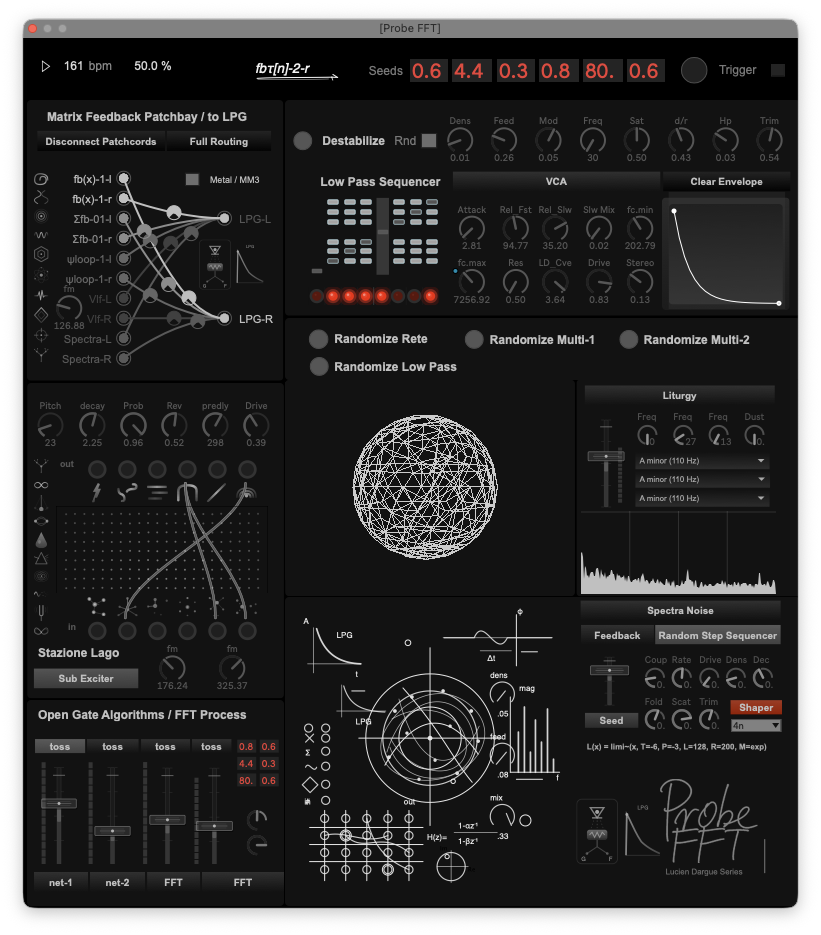
Probe FFT is an organic percussion, texture and soundscape generator for Max for Live built around excitation synthesis, FFT processes and Parker/D'Angelo Low Pass Gate articulation.
The system combines synthetic excitation sources, recursive feedback structures, probabilistic modulation and spectral transformations to generate unstable rhythmic structures, resonant accumulations, immersive textures and continuously evolving sonic environments.
What is FFT?
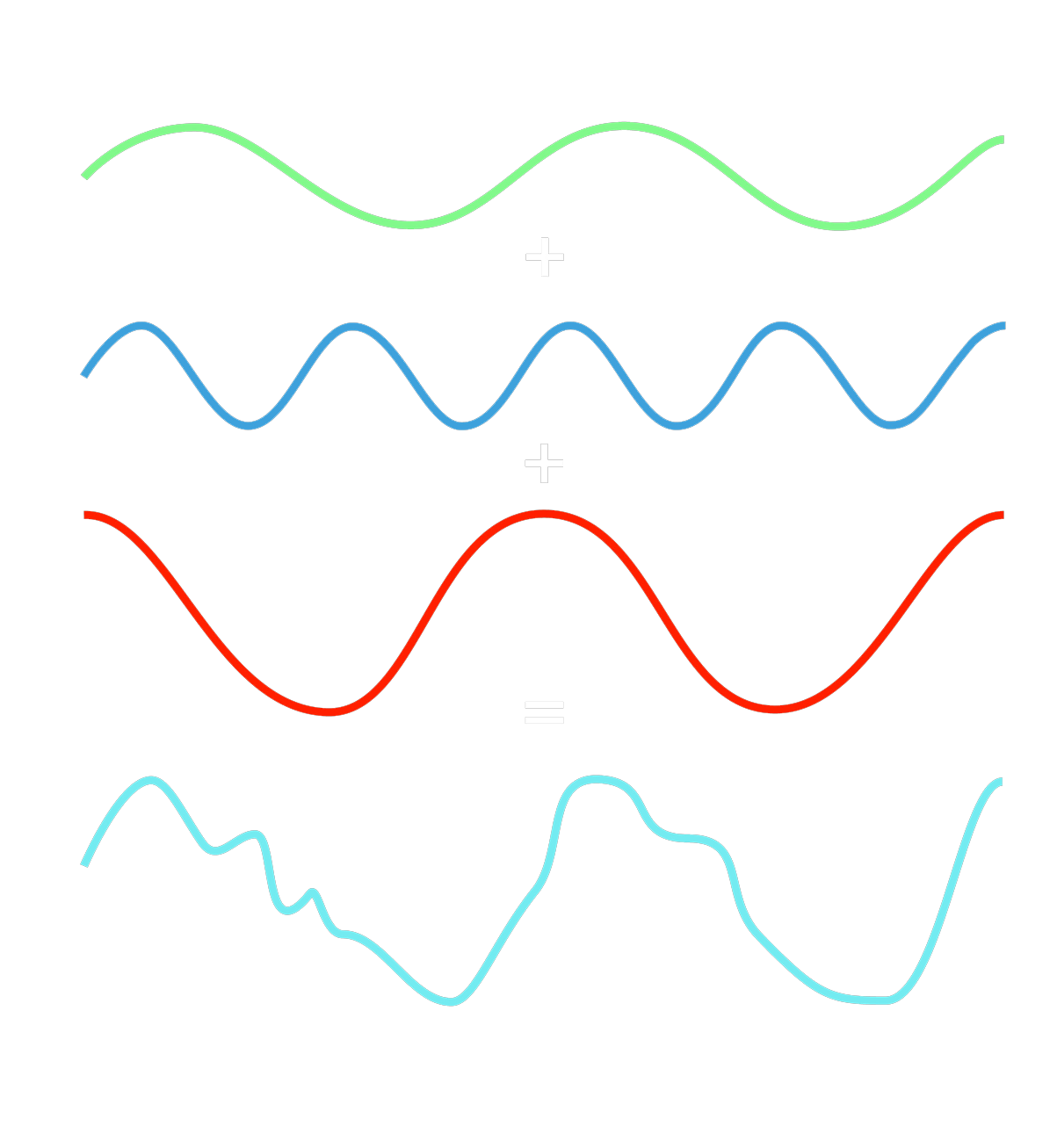
FFT — Fast Fourier Transform — is a mathematical process that decomposes a sound signal into its individual frequency components. Instead of hearing a sound as a single waveform, FFT reveals the thousands of simultaneous frequencies that make up that sound at any given moment: every partial, every harmonic, every trace of noise.
Each of these individual frequency components is called a bin. A single FFT frame can contain hundreds or thousands of bins, each one representing a narrow slice of the frequency spectrum with its own amplitude and phase. Together, these bins form a complete spectral snapshot of the sound.
What makes FFT powerful in a system like Probe FFT is that once a signal has been decomposed into bins, each bin can be independently manipulated: amplified, attenuated, frozen, randomized, eroded, accumulated or removed entirely. This allows transformations that would be impossible with conventional filters — operating directly on the internal spectral structure of the sound rather than on its surface.
Parker / D'Angelo LPG
The Parker/D'Angelo LPG model derived from Vortessa is used here as a dynamic articulation structure: physically modelled vactrol response, non-linear decay behaviour, energy-dependent articulation and stereo asymmetries continuously reshape the behaviour of the excitation systems.
Internal sources can simultaneously operate in two different states: as open gate generators for textures, drones and soundscapes, or routed into the LPG network for unstable organic percussive articulation and transient excitation.
The same excitation systems can therefore coexist simultaneously as sustained resonances, spectral masses, atmospheric accumulations and articulated percussive structures.
Spectral Engine
Behind Probe FFT's small panel hides more than 38,000 lines of JSON and Max/MSP code, distributed across stochastic modulation systems, dynamic routing matrices, FFT structures, recursive feedback networks, algorithmic percussion engines, spectral processes and LPG articulation systems.
FFT processes continuously analyse the signal into spectral components and directly transform its internal structure: frequencies can be retained, fragmented, destabilized or removed entirely. The result is not a conventional filtering process but a continuous transformation of the sound material at the level of individual spectral bins.
Spectral Bins
FFT bins can be destabilized, compressed, eroded, emptied or accumulated over time, generating spectral voids, metallic resonances, unstable harmonic residues, frozen tails, fragmented transients and recursive spectral feedback structures in constant mutation.
The spectral distribution itself never remains static: energy density, harmonic concentration and spectral behaviour are continuously reorganized by the internal stochastic matrices, allowing the sound material to collapse between percussive states, noise masses, harmonic resonances and atmospheric textures.
Spectral Sampler
At the heart of Probe FFT lies a spectral sampling engine that operates entirely in the frequency domain. Any audio source — a field recording, a drum hit, a noise texture, a voice — can be loaded, spectrally analysed frame by frame, and stored as a complete spectral snapshot: thousands of individual frequency bins, each preserving its own amplitude and phase information across time.
Once the spectral buffer is filled, the sound no longer exists as a waveform. It exists as a malleable frequency structure — a frozen spectral body that can be reshaped, destabilized, stretched, scattered and recombined through independent bin-level control. This is not sample playback. This is spectral material that can be sculpted into textures, timbres and temporal behaviours that would be impossible to achieve through conventional synthesis or processing.
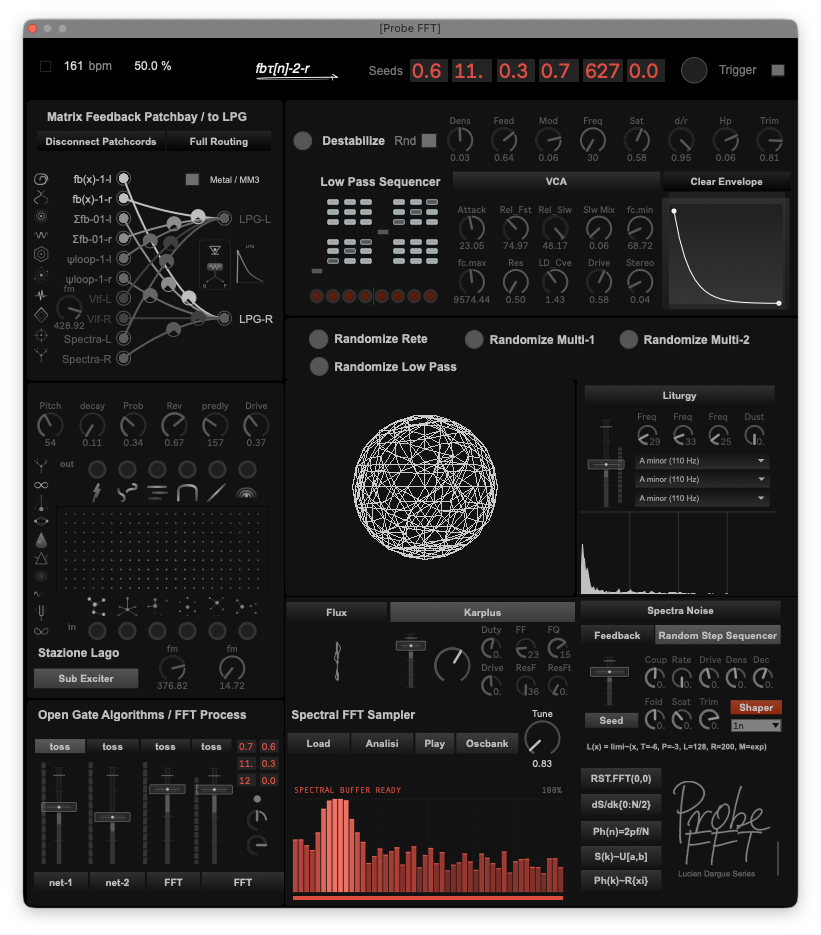
Spectral Sampler — FFT analysis scope, oscillator bank and spectral transformation controls
Spectral Analysis
Audio is loaded into the source buffer and then scanned through a high-resolution FFT analysis process. The engine decomposes the entire signal into its constituent spectral frames — a complete bin-by-bin portrait of the frequency content over time. A dedicated spectral scope provides real-time visual feedback during the analysis, tracking the progression of the scan across the full frequency range.
Once the analysis is complete, the spectral buffer holds the entire frequency structure of the source material, ready to be resynthesised and transformed through the oscillator bank and the spectral transformation algorithms.
Additive Oscillator Bank
The analysed spectral data can be resynthesised through an additive oscillator bank that reconstructs the sound from its individual frequency components. Each bin drives its own oscillator, producing a faithful reconstruction of the original spectrum that can then be continuously manipulated in ways that depart radically from the source.
Spectral Transformations
The spectral sampler exposes a set of transformation algorithms that operate directly on the bin structure of the analysed material. Each algorithm reconfigures the spectral behaviour in a fundamentally different way:
LIN.SPD(N/2)
Applies a linear speed distribution across all spectral bins. Lower bins move slower, higher bins move faster — or vice versa — creating continuous spectral drift, temporal smearing and frequency-dependent time stretching across the entire spectrum.
LIN.PHS(2kN)
Distributes a linear phase offset ramp across all bins. This displaces the temporal alignment of each frequency component, generating phase-based spectral diffusion, timbral blurring and spatial dispersal of the harmonic structure.
RND.SPD[a,b]
Randomizes the playback speed of each bin independently within defined boundaries. The spectral content begins to fragment, stutter, stretch and contract at different rates across the frequency range — producing granular-like spectral disintegration from a single analysed source.
RND.PHS[0,1]
Randomizes the phase position of each bin across the full range. The temporal coherence of the original material dissolves entirely, redistributing spectral energy into new configurations that retain the timbral character of the source while destroying its original temporal structure.
RST.FFT(0,0)
Resets all bins to their original analysed state — restoring the faithful spectral reconstruction of the source material as captured during the initial scan.
These transformations can be applied, combined, and continuously reapplied in any order. Each interaction reshapes the spectral body differently, and because every bin responds independently, the results are never predictable in the same way twice.
Through the spectral sampler, any recorded material — a contact microphone capture, a resonant metal plate, a voice, a synthesized texture — can be decomposed and reshaped into evolving spectral textures, frozen timbral masses, granular spectral clouds and slowly mutating harmonic fields. The results integrate naturally with contemporary sonic practices: lowercase, electroacoustic composition, microsound, sound design, noise and experimental electronic music.
Spectral Material Through the LPG
The spectral sampler output can be routed directly into the Parker/D'Angelo Low Pass Gate network. This is where the two core architectures of Probe FFT converge — spectrally transformed material enters a physically modelled vactrol system whose non-linear decay, energy-dependent response and frequency-dependent attenuation are fundamentally shaped by the complexity of the input signal.
Low Pass Gates respond with far greater nuance and organic articulation when driven by spectrally rich, harmonically dense material. A single sine wave passing through a vactrol produces a simple amplitude contour. But a spectrally decomposed texture — a frozen cloud of thousands of independent frequency components, each with its own amplitude and phase trajectory — excites the LPG across its entire response surface simultaneously. The vactrol's inherent non-linearity means that each frequency component decays at a slightly different rate, producing the kind of timbral evolution and natural-sounding transient behaviour that defines acoustic percussion: the bright attack components vanishing first, the lower partials sustaining and darkening as the gate closes.
The result is that spectrally transformed material — phase-scattered, time-stretched, frequency-randomized — acquires an unmistakably organic percussive quality when articulated through the LPG. Strikes become spectrally alive: dense, complex, continuously shifting in harmonic content, yet shaped by the same energy-dependent decay curves that give acoustic instruments their natural dynamic character.
By feeding the spectral sampler into the LPG network, Probe FFT closes the loop between spectral decomposition and physical articulation — the same material can exist as a frozen timbral mass, a granular spectral cloud, and an organically decaying percussive strike within the same system.
Sequencer
The internal sequencer does not use a traditional linear programming structure but continuously generates temporal drift, probabilistic mutations, rhythmic collisions, density fluctuations and energetic reconfigurations of the sonic behaviour.
Routing Matrices
The system integrates two independent patchbay matrices.
The first controls the routing of algorithmic excitation sources into the stereo Low Pass Gate network, continuously reconfiguring percussive behaviour, dynamic articulation, energy response and the interaction between excitation structures, recursive feedback systems and LPG resonant states.
The second patchbay operates as a routing matrix between open gate generators, FFT structures, recursive feedback networks and resonant layers, allowing sources to simultaneously exist as atmospheric textures, immersive drones, spectral masses and articulated percussive material.
Connections can be continuously destabilized, mutated and reorganized by the internal probabilistic systems, generating unstable sonic networks in which routing behaviour, spectral density, energetic distribution and rhythmic articulation constantly evolve over time.
Probe FFT is the first Max for Live percussive system built around a dynamic Low Pass Gate matrix simultaneously oriented toward percussion, texture generation and spectral behaviour.
Inside the Patch
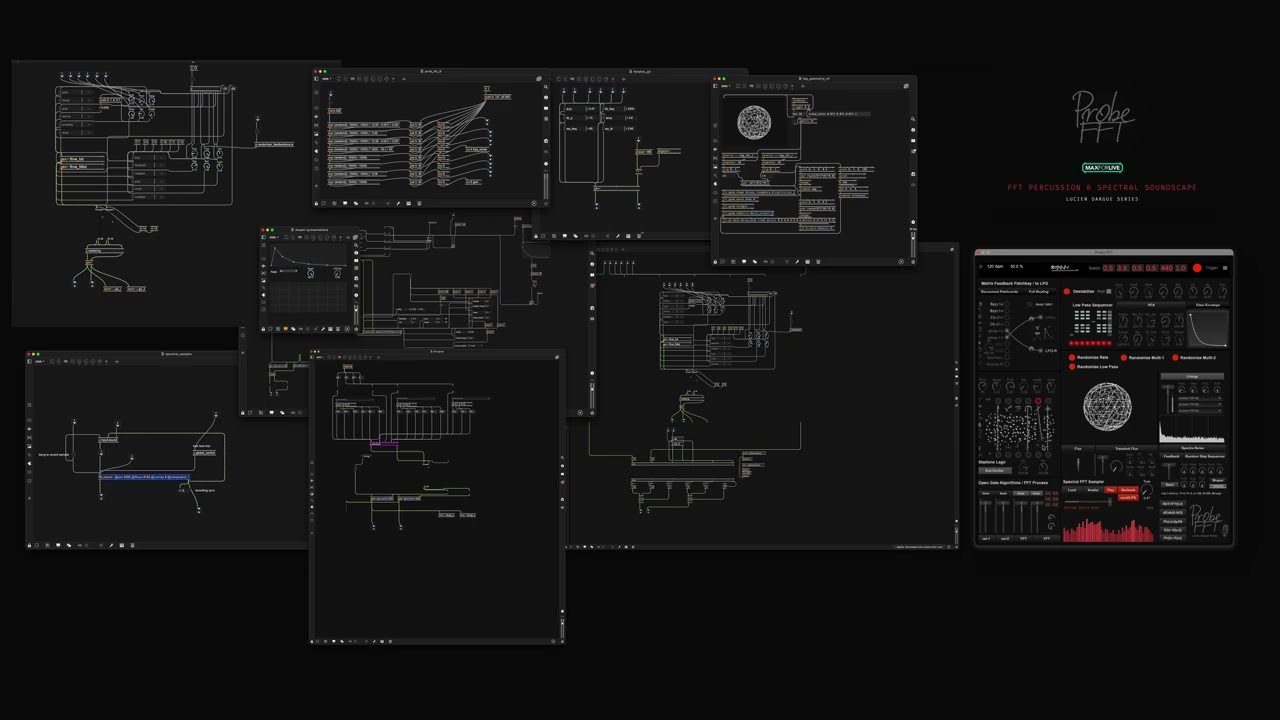
Behind the compact interface of Probe FFT lies a deeply interconnected architecture of abstractions, subpatchers, signal routing, feedback networks and gen~ structures. More than 38,000 lines of code orchestrate excitation synthesis, spectral processes, LPG articulation and stochastic modulation into a continuously evolving sonic system.
Ableton Live Integration
The entire architecture was designed around continuous modulation: routing, density, articulation, feedback behaviour, energetic states, FFT structures and resonant responses can all be transformed in real time both by the internal stochastic matrices and by full Ableton Live automation.
Every parameter inside the system is fully automatable and deeply integrated with the modulation ecosystem of Live: automation lanes, LFOs, envelope followers, randomization systems, macros, gestural control and external modulation sources can simultaneously interact with the internal probabilistic networks and energetic structures of the device.
The system merges internal algorithmic modulation with external performative control into a continuously unstable architecture where synthetic excitation systems, spectral processes and recursive feedback structures evolve as dynamic sonic ecosystems rather than static patterns or conventional drum sequencing workflows.
Not a Drum Machine
Probe FFT is not based around static sample playback or traditional drum machine structures.
The focus of the system is the continuous interaction between percussion, resonance, texture, feedback, LPG articulation and spectral transformation.
Exploration
As with all systems in the series, Probe FFT requires extensive exploration.
Some functions are labelled through tooltips, allowing users to read descriptions simply by hovering the mouse over the interface. However, due to the highly non-linear and idiosyncratic nature of the system, virtually any combination can produce unexpected and often surprising results.
Probe FFT behaves more like a futuristic noise generation ecosystem than a conventional instrument. Because of this, it is generally recommended to begin slowly: connect one cable at a time inside the patchbays, press backspace in Ableton Live to start the sequencer, experiment with enabling and disabling the 8-step structures, and gradually activate the open gate sources while interacting with both localized and global randomization states.
There are genuinely hundreds of possible interactions inside the system, and nearly every careful experiment can produce highly characteristic sonic behaviours.
As with the other systems in the series, many of the textures are autopoietic in nature: in many situations it is better to simply let the system run and wait for accumulations, releases of energy and pressure states to emerge naturally over time.
Probe FFT requires patience and study because, in many ways, it behaves more like a modular ecosystem than a conventional Max for Live device.
Summer Mix
In 2011, Theo Burt released Automatics Group / Summer Mix on Entr'acte — a record that applies a discrete Fourier transform to a collection of late '90s and '00s dance anthems, discarding all phase data and retaining only the frequency content.
The result is one of the uncanniest documents in recent computer music: snare hits smeared as thin layers of noise across the entire duration, single synth notes stretched into pulsating chords spanning whole tracks. What remains is a haunting spectral impression — a ghostly, diffused memory of the original material where time has been dissolved and only timbral residue survives.
The process reveals something fundamental about the relationship between time and frequency. When half the information in a recording is removed — specifically the half that encodes temporal and structural relationships — what persists is not silence but a strange, suspended sonic field. Repetitive structures partially survive the transformation, emerging as phantom rhythms inside the spectral haze.
Boomkat described it as "a non-trivial nostalgia trip that somehow sounds like a digitally diffused, skeletal take on Gas, Basic Channel or Ross 154" — and it is precisely this quality of spectral haunting, of sound material that retains its timbral identity while losing its temporal coherence, that resonates deeply with the philosophy behind Probe FFT's spectral sampler.
Requirements
Ableton Live 12 with Max for Live.
The Ecosystem
Probe FFT belongs to a coherent suite of instruments for deep sonic exploration. Each tool addresses a different relationship between composer and sound material.
Probe FFT
FFT Percussion & Spectral Soundscape for Max for Live. Lucien Dargue Series
Orbit
Esoteric Feedback Instrument for Max for Live. Lucien Dargue Series
Vortessa
Chaotic Synthesis & Spectral Ecosystem for Max/MSP. Lucien Dargue Series
Endogen
Synthesis and advanced sampling environment for lowercase, microsound, and drone
Assembly-7
Polymetric algorithmic drum synthesizer
Interfera
Geosonic Field Recordings Engine

Lucien Dargue